
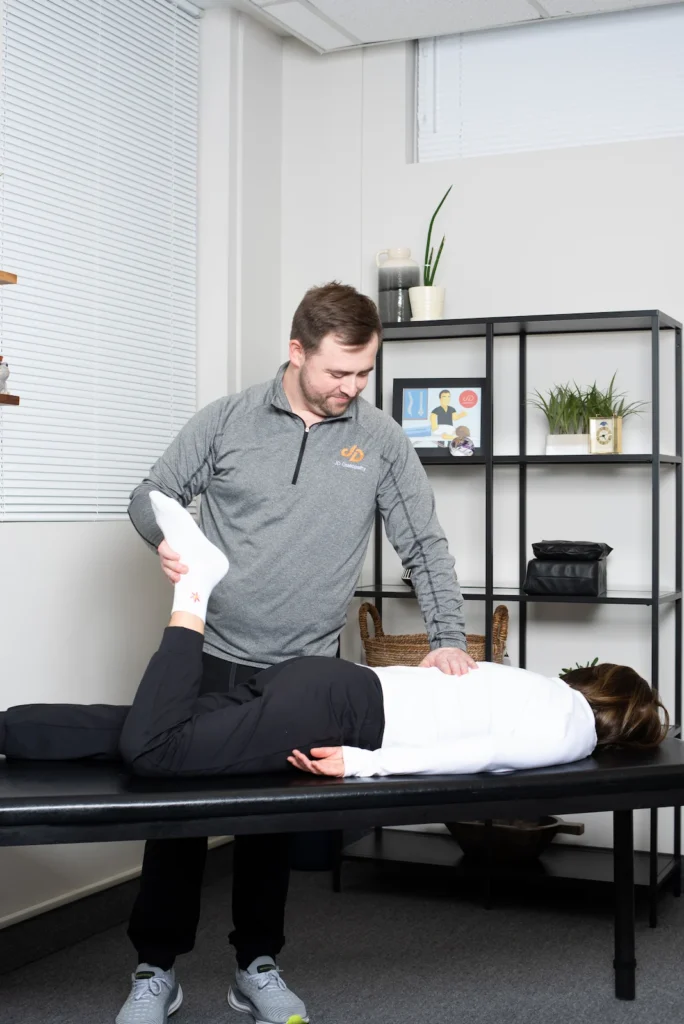
Can an Osteopath Fix a Pelvic Tilt? Your Typical Advice Exposed.
The short version: A pelvic tilt is usually not the real problem. It is the body’s way of staying balanced when something above or below the pelvis cannot move well, so the pelvis tips to keep you upright and your eyes level.
That is why stretching and strengthening often do not hold. The fix is to find the actual restriction and free it up, and once that is gone the pelvis has no reason to stay tilted. In most cases the pelvis moves better, or sits much more level, within one to three treatments. If your tilt feels structural or longstanding, the goal becomes better movement through the whole spine rather than forcing a perfectly neutral pelvis.
Most people who ask this question didn’t notice the tilt themselves. A trainer, a Pilates instructor, or a yoga teacher pointed it out, and now it feels like a flaw that needs correcting. You’ve probably already tried the standard advice. Stretch the hip flexors, strengthen the glutes and abs, tuck the pelvis under. If you’re reading this, that advice likely didn’t hold, or it never worked in the first place.
Here’s the short answer. Yes, a pelvic tilt can usually be changed, and often in real time during a treatment. But not the way most people think, and not by working on the pelvis itself. Let me explain what I actually find when someone comes in for this.
Most people who ask this question didn’t notice the tilt themselves. A trainer, a Pilates instructor, or a yoga teacher pointed it out, and now it feels like a flaw that needs correcting. You’ve probably already tried the standard advice. Stretch the hip flexors, strengthen the glutes and abs, tuck the pelvis under. If you’re reading this, that advice likely didn’t hold, or it never worked in the first place.
Here’s the short answer. Yes, a pelvic tilt can usually be changed, and often in real time during a treatment. But not the way most people think, and not by working on the pelvis itself. Let me explain what I actually find when someone comes in for this.
Is a Pelvic tilt a problem or a solution?
The biggest mistake I see is tunnel vision on the pelvis. Everyone looks at the static position and assumes it’s an error to be fixed. Almost nobody asks the more important question. Is this tilt a cause, or is it an effect? Is it a fault, or is it your body’s solution to a problem somewhere else?
The pelvis is a cornerstone. It’s the intersection that stabilizes your lumbar spine, and it’s the anchor the whole spine sits on top of. So when the feet and legs are fixed to the ground and there’s no more room for movement from above, the pelvis tilts as a reaction. In an anterior tilt, that usually shows up as too much tension through the hamstrings and too much slack through the abdomen and hip flexors.
The point is this. Your body is only holding a tilt to make sure you don’t tip over. It’s balancing. Before we call it broken, we have to ask what it’s trying to accomplish.
Why the static position tells you almost nothing
A pelvis can sit in an anterior tilt and still move forward and backward freely with no restriction. If that’s the case, it isn’t really a pelvic tilt issue. The tilt is a counterbalance for something happening above it or below it.
That’s why I don’t get caught up in the position you’re frozen in. I care about your movement ability. The static picture doesn’t tell me what the culprit is. The way your body moves does.
Side view. The eyes stay near the centre line and your weight stays over your feet. As the chest tips forward the neck bends back to keep the head up, and the pelvis rolls anterior to balance you, which lengthens the front of the abdomen. The pelvis is not the problem. It is the small compensation that keeps you from tipping over.
How I work out what's actually causing it
We have to rule things out to get a true understanding. The tilt could be coming from the spine, the pelvis itself, the lower limbs, or even the head and the way your eyes and ears are reading the world. So I start before I even put my hands on you.
First I watch how you move standing, bending forward and backward, looking for restrictions or deviations. Then I have you do that same forward and backward movement seated and compare. If the movement changes once you sit down, that tells me the lower legs were part of the restriction, because sitting takes them out of the equation.
From there I look at how the lumbar spine moves, because the lumbar spine dictates most of the pelvic tilt movement through the sacrum, the lumbosacral junction, and the sacroiliac joint. If I see the lumbar spine sitting in extension, I'll usually see the pelvis coming along for the ride and rolling anterior. The pelvis is following orders from above. This is the same whole-body logic behind why your osteopath treats areas away from your pain, and it's exactly what my hands are feeling for during an assessment.
What's actually holding the pelvis there
Picture the pelvis from the side as a wheel or a pulley. As it tilts forward and the wheel turns, the attachments on the back, like the hamstrings, get pulled tight. At the same time the abdominal muscles and hip flexors on the front lengthen and go slack.
So the gym logic looks sound. Contract the abs and the glutes, shorten what's lengthened, and pull the wheel back the other way to tip the pelvis posterior. The reasoning checks out. The problem is leverage, specifically when the real restriction is not at the pelvis or the lumbar spine at all.
A common example
Say your head and neck are carried forward, the way they often sit after years of desk work, and your eyes and ears are sending the message that you're tipping too far forward. Your spinal extension muscles fire to keep you upright, your lumbar spine has to stay in extension to compensate, and your pelvis is stuck in that anterior pelvic tilt as a result. You can strengthen and stretch all you want, but you cannot out-muscle that amount of leverage pulling from the other end of the body. This is the same righting-reflex relationship I see driving a lot of stubborn neck pain that keeps coming back.
If you've tried the stretches and the strengthening and nothing changed, you are not going crazy, and you are not doing it wrong. You're just being asked to overcome leverage that's pulling to the pelvis, not at the pelvis, coming from somewhere else entirely.
So can a pelvic tilt actually be fixed?
Yes. And it's not magic, it's mechanics and leverage.
Because the position is usually caused by something pulling or holding the pelvis, not the pelvis failing on its own, the job is to find what's doing the holding. We deduce that by ruling out what moves and what doesn't. Once we address the restriction in movement, the pelvis has no reason not to sit neutral. It was only tilting to keep you balanced. Take away the reason, and it stops overcorrecting.
What makes the change hold is that we're not forcing anything. Once we remove the roadblocks to your movement, your body goes back to moving and re-establishes a proper pattern on its own. My job is to make moving in a neutral position easier and natural, not to shove you into a posture you then have to white-knuckle. That's the difference between a real correction and just temporarily pushing tissue around.
When you should leave a pelvic tilt alone
Not every tilt needs erasing. If you're forcing a neutral pelvis only because someone told you to, and it stays uncomfortable no matter how hard you try, that discomfort is information. It means there's a genuine limitation, and it isn't for lack of effort.
Sometimes there are structural reasons. A scoliosis, a kyphosis of the thoracic spine, or other conditions that create rigidity can limit how much the whole spine moves. Even then, chasing a perfectly level pelvis is usually the wrong target. The better goal is to get as much movement as possible from the entire spine, so we're not dumping all the stress onto the pelvic tilt and romanticizing it as the one thing to fix. You get more movement in the pelvis when the whole spine moves well, because the pelvis is just the anchor of the spine. We can't ignore every segment sitting above it. The hip and lower body and the low back are part of that same chain.
A quick word on effort. Working on a pelvic tilt isn't a waste of time, but if you've put in a couple of weeks of real work and seen little or no progress, there's no sense grinding away at the same approach. That's the signal to look elsewhere and have someone assess the whole picture.
What treatment looks like at JD Osteopathy
When someone comes in for this, I can often get the pelvis moving better, or at least sitting much more level, within one to three treatments. Plenty of people feel a difference after the first visit. The timeline shifts with variables like how long you've had it. The aim each session is to stack progress, watch the alignment correct itself, and make sure the change holds rather than slipping back. It's the same approach behind my treatment for pelvic and sacral pain in Mississauga.
One thing before you book. A pelvic tilt itself is a movement and structure issue, not a disease. But if your low back or pelvic symptoms come with leg numbness, weakness, or any change in bladder or bowel control, please get that checked by a doctor first. Those are not pelvic tilt problems.
Otherwise, the thing I want you to stop worrying about the moment you walk out is the mirror. Your pelvic tilt isn't broken and you didn't cause it by sitting wrong. It's solving a balance problem the best way it knows how. Give it a better reason, and it stops needing to overcorrect.
JD Osteopathy serves patients across Mississauga and Burlington. Our osteopathic practitioners hold a Master in the Practice of Osteopathic Manipulative Sciences (M.OMSc.) from the Canadian Academy of Osteopathy - the highest level of osteopathic education available in Ontario.
About the author: Dmitro Jovnyruk, M.OMSc. is an Osteopathic Manual Practitioner and Founder of JD Osteopathy with clinics in Mississauga and Burlington. His practice focuses on identifying the underlying mechanical causes of pain and discomfort through osteopathic assessment and treatment. Read Full Bio
2 Comments
Comments are closed.