

What Does an Osteopath Feel For During Treatment?
What is your osteopath actually sensing during treatment? JD Osteopathy explains what hands-on assessment reveals — temperature, tissue quality, movement, and more.
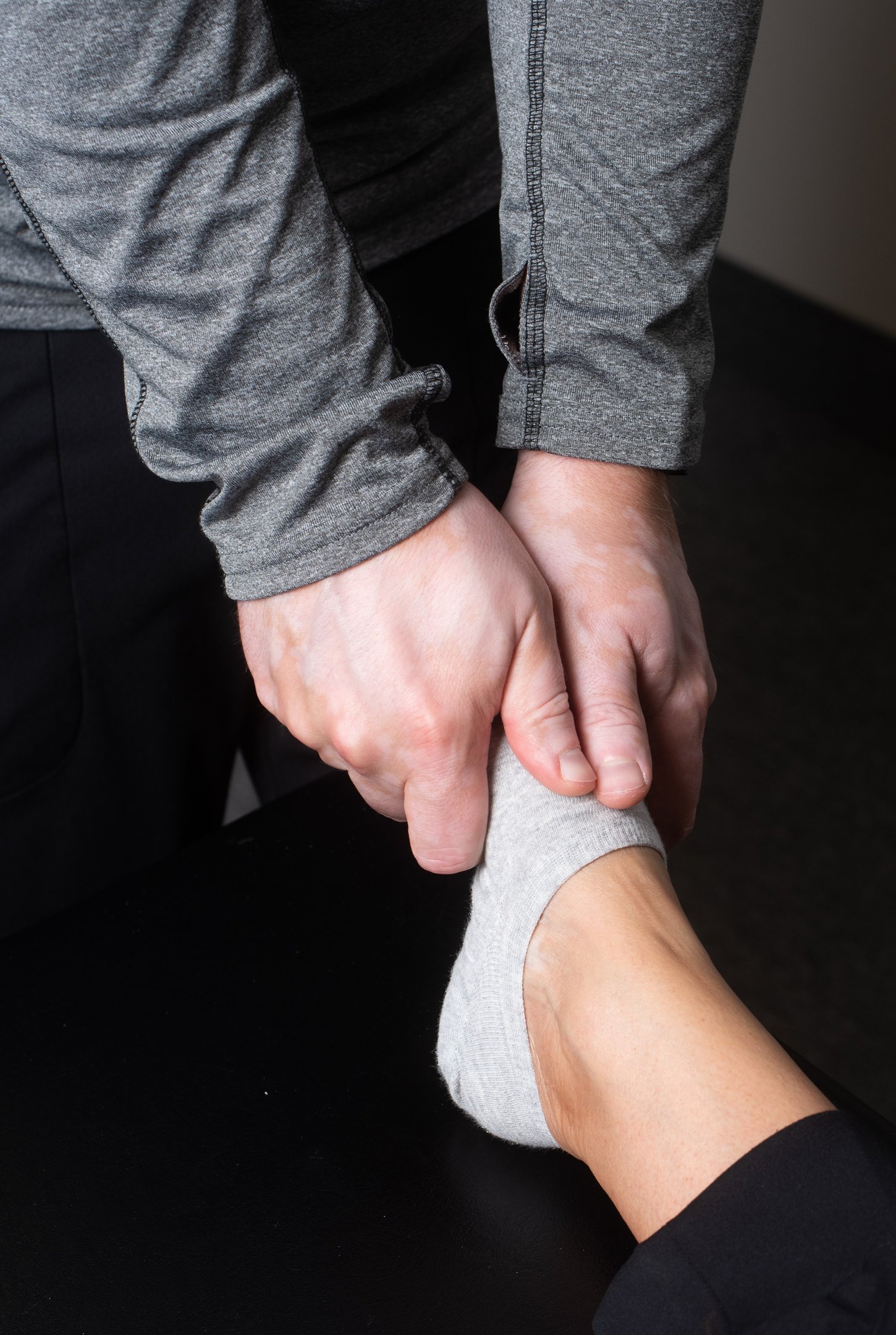
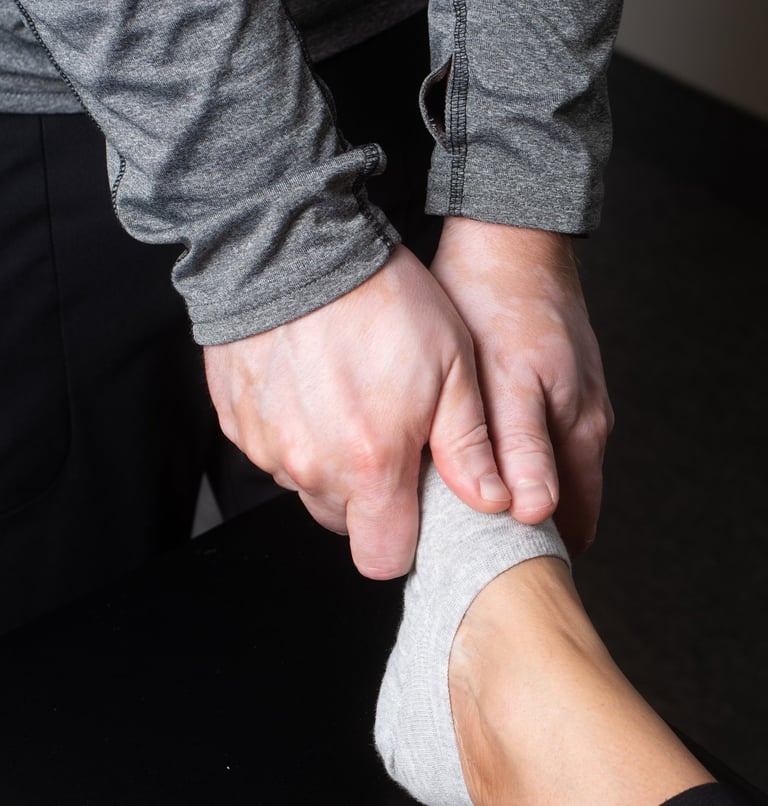
Most patients lie on the treatment table with a version of the same question running quietly in the background: what exactly is happening right now? What are those hands looking for? How does moving my arm tell you anything about my neck?
This post is the honest answer to that question - written for patients, not practitioners.
It Starts Before the Treatment Does
The approach I take with all osteopathic patients is that the assessment is always happening and always the basis of our decision making. The assessment begins the moment I meet, and in some ways, even before movement starts at all.
Before I ask anything to move, I'm already gathering information through touch alone. Temperature is one of the first things I notice. Areas that are working harder than they should, such as tissues under chronic strain, joints that are overloaded, regions where circulation is compromised, are often present with subtle temperature differences. Warmer can indicate increased activity or inflammation. Cooler can suggest reduced circulation to an area or more longterm chronic injuries where lack of movement has reduced the mechanical aid of pumping blood to the area.
I'm feeling the quality of the skin itself and whether it has good elasticity and hydration, or whether it's become slightly tethered or resistant. Skin that doesn't glide freely via the fascial tissue (from the superficial fascia) beneath it is often reflecting something happening deeper.
I'm feeling for pulse, not just at the wrist, but at the ankles and through the abdomen and rib cage. The quality and rhythm of circulation through different parts of the body gives information about how the vascular system is managing and whether certain regions are receiving and draining properly. This again, is just a byproduct of whether the body is having an easier or relatively harder time moving - moving not just the bones and joints, but everything else in between.
I am watching and feeling how you breathe, not just the rate, but the quality of it. Does the rib cage expand freely and symmetrically? Is one side moving differently from the other? Is the breath easy or effortful? Does it involve the upper chest more than the lower, suggesting the lower ribs and diaphragm isn't fully able to expand? The breathing mechanism involves the thoracic spine, the ribs, lumbar spine and the diaphragm, proper nerve signal from the neck (phrenic nerve) and even the sacrum at the base of the spine. Not to mention, all of the surrounding fascia and all structures wrapping the body. How they move with each breath tells me something about all of them before I've asked a single joint to move.
The Art of Comparative Assessment
Once movement begins, the principle running through everything is comparison, but specifically, comparison within the individual patient rather than against an external standard.
There's no universal benchmark for how a knee should bend or how an arm should rotate. What matters is how your left compares to your right, how your hip compares to your shoulder, how a movement at one end of the body relates to what I feel at the other. Everything is relative to you. I ask "is this functional for the patient?...is there anything impacting movement and anatomy from working correctly?" These are all principles of osteopathy stated by the founder Dr. Andrew Taylor Still. Structure dictates function, the body is a dynamic unit of function, the body is self-healing and self-regulating. Osteopathic treatment and the corrective decisions are dictated by those principles.
What I'm assessing across every movement is three things: quantity, quality, and connection.
Quantity of the range; how much movement is available. But this is actually the least interesting of the three because restricted range is the end result, not the cause.
Quality is where the real information is. Does the movement feel easy and smooth? Or is there a sense of effort, drag, or resistance as I guide it? Does it feel like the tissue is yielding appropriately, or is there a density, a sense that something is holding on rather than letting go? Not only that, but how quickly during the movement does the restriction engage. Healthy tissue has a certain liveliness to it. It responds, gives, and returns. Restricted tissue can feel dense, almost wooden in comparison or sometimes surprisingly heavy, as if the limb has lost its own participation in the movement.
Connection is what I find most revealing. When I move one part of the body, I'm not just assessing that part, I'm feeling what happens everywhere else. If I bend your knee, does your lumbar spine remain still, or does it begin to rotate? If I lift your arm, does your shoulder blade move freely on the rib cage beneath it, or does the whole thorax compensate? And critically — how early does that connection engage?
That last detail matters enormously. In a well-functioning body, connections between regions engage in a smooth, sequenced, appropriate way. When something isn't working correctly, the connection happens too early — before the segment that should be doing the work has had the chance to do it. The body recruits a workaround before the primary mover has even been properly asked. That premature engagement is a signal. It tells me both what isn't working and how far the compensation has spread.
The Finding That Still Surprises Me
Even after years of practice, the finding I encounter most often is one that consistently surprises patients, and honestly still strikes me each time.
The pain is almost never the problem. It's a reaction to the problem.
When a patient comes in with pain on one side, a chronic ache in the right shoulder, a persistent tightness in the left hip, a recurring tension in one side of the neck... the instinct is to find the problem at the site of the pain. When I assess that area, it often moves reasonably well...better than you'd think.
What I find instead is that the area causing the pain is actually the area working hardest to compensate for a restriction somewhere else. It's the structure that's being pulled and it's at the end of the line...it reacts by contracting so not to further damage. The tissue more so responds by holding on continuously to keep the body centred, because something on the other side, or further up or down the chain, isn't pulling its weight so the troubled area has no choice but to pick up the slack because, well...it CAN move.
The painful area is the one that's been working overtime. The restricted area is often quiet, sometimes painless, sometimes barely noticed by the patient at all because it cannot move well to begin with. The body has an intuitive way to "get the job done" and has many backup plans. The areas that can move WILL move, almost to a fault.
This is why treating only where it hurts produces temporary relief. Imagine you've been working a double shift and someone comes around and beats you up with hard pushes and prods. That's what we often do to tired and overworked tissues...we push and prod, heavy stretches, devices that stimulate and aid us in overstimulating it. That is almost never the answer. When we offload the work, the body has no reason to send the signal to keep firing... It relaxes, the patient feels better, they return to activity, and the same demand is placed on the proper system and dispersed properly.
JD Osteopathy serves patients across Mississauga and Burlington. Our osteopathic practitioners hold a Master in the Practice of Osteopathic Manipulative Sciences (M.OMSc.) from the Canadian Academy of Osteopathy — the highest level of osteopathic education available in Ontario.
Why This Matters for Your Treatment
Understanding what we're assessing changes what you should pay attention to during and after a session.
When I work somewhere that isn't where your pain is, or when I spend time on your thoracic spine for a shoulder complaint, or your hip for a knee problem... it's because the assessment found something there. The connection between that area and your primary complaint was detectable through the quality, timing, and behaviour of movement. I'm following what I find, not what the symptom map suggests.
When something surprises you, a spot that turns out to be more tender than expected, a movement that produces a sensation somewhere else entirely, a limb that feels notably heavier than its counterpart, these aren't incidental. They're the body giving information that a conversation alone could never produce.
The hands are listening. Every contact is a question the tissue answers.
JD Osteopathy is located at 5025 Orbitor Drive, Building 1, Unit 101 in Mississauga, and 3141 Walkers Line in Burlington. No referral required.