The short version: Most stiffness and pain in later life gets blamed on age, but age is rarely the real reason. The body is working harder because an issue went unaddressed for a long time, not because the calendar turned over. Osteopathy for seniors is an easy way to help with crucial mobility restriction. With older patients the goal is not to fix every restriction. It is to free the key crossroads of movement, like the T11 to L1 junction where so much rotation and force transfer happens, so the body has less work to do to hold you upright and keep you moving. The approach is light, goal-oriented, and careful: assess more, treat less, and never strip away tension that is quietly doing a job. If you fall and are in pain, or have sudden weakness, numbness, balance, speech, or taste changes, see a doctor first. Otherwise, the message is simple. Your body has not given up on you, and neither should you.
Osteopathy for Seniors
Most stiffness and pain in later life gets blamed on age. After years of treating older bodies, the real story is almost always something different.
An older body works harder, not because it is old, but because a long-standing issue never got addressed and has had years to build compensations around it.
Hips and knees have more room to move, so when the areas above them stiffen, they pick up the extra work simply because they can. That extra load is what leaves them irritated.
A lot of that tightness is quietly holding your posture together, so the footprint stays small. We assess more and treat less, lighter at first, to see how your body responds before doing more.
The aim is not to fix everything. It is to free the key junctions where movement passes through, like the T11 to L1 region that drives rotation between your upper and lower body.
Walking, water aerobics, gentle strength work. Healthy load keeps bone and tendons strong, and the activity you enjoy is the one you will actually keep doing.
When to see your doctor first
If you have had a fall and are in pain, or notice sudden weakness, numbness, or changes in balance, speech, or taste, see a doctor first. Manual osteopathy is for the mechanical, movement-related side once those are ruled out.
Stop blaming your age. Your body has not given up on you, and neither should you.
If you are older and dealing with pain or stiffness, you have probably been told some version of “well, that’s just your age.” Maybe you have started to believe it. The knees, the back, the shoulder that will not lift, all filed under getting old and nothing to be done.
I want to push back on that, because after years of treating older bodies, I have come to see it differently. The problem is almost never the age. Let me explain what is really going on.
It is not the age, it is the time
Here is the distinction that changes everything. An older body is often working harder than a younger one, but not because it is old. It is working harder because it has had an issue that never got properly addressed, and it has had far more time to build compensations around it.
Give any body decades to work around a restriction and it will. The pattern just gets deeper and more layered with time. So when an older patient struggles, what I am usually looking at is not age-related decline. It is a long-standing problem that has been quietly compensated for, for years.
The principles I work with do not change with age. I treat the patient, not the demographic. I treat the anatomy. The only thing that shifts is which layers are driving the pattern, and how much I should do about them. It is the same whole-body reasoning behind why your osteopath treats areas away from your pain.
Why the joints that move get sore
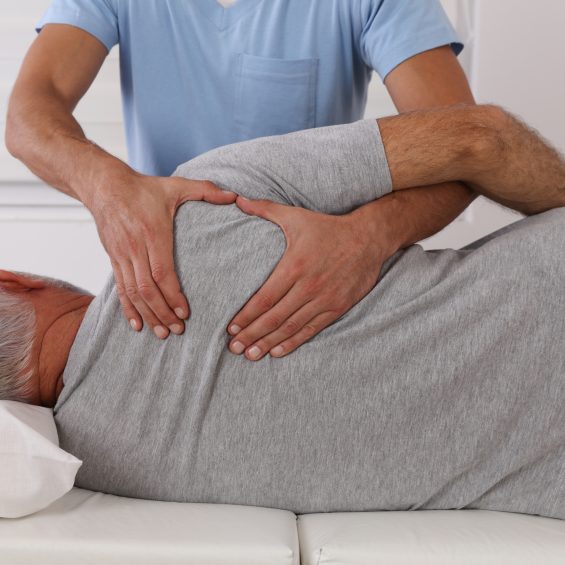
Older patients often come in with their high-mobility joints irritated, the hips the knees. There is a reason for that. Those joints exist to move. But when the system above them is rigid and overall flexibility has dropped, those joints start moving incorrectly to make up for it, and they get irritated. The ligaments and joint surfaces tend to feel it the most.
Underneath that, the lumbar and pelvic region is usually rigid, with the muscles on the back of the body, the erectors and the hamstrings, contracting hard just to keep the person upright. Picture that for a moment. A good part of someone’s daily effort is going into simply holding themselves up. Sometimes all it takes is relaxing those posterior muscles and restoring a little gentle flexion and extension, so the body does not have to work so hard to stand.
This is also why strength training matters so much in older age. The body needs enough healthy stress to keep producing bone and to keep the tendon attachments strong where they anchor to bone. Movement and load are not the enemy here. They are part of the medicine.
Osteopathy for Seniors Aims to Treat less, Assess more
This is where treating an older body genuinely differs in practice. I want to keep the treatment footprint small. I am choosier about what I address, I assess more, and I treat less.
Part of that is caution, and part of it is respect for what the body is doing. In an older patient, a lot of that tightness around the spine is holding their posture and stability together. If I treated too generally for too long and stripped all of it away, I could take away something they were leaning on. So I do not. It is not always about a lighter touch or less pressure. It is about less impact and less overall dosage of treatment, especially on a first visit, where I keep things very light to see how the body responds before doing more.
The goal is movement, not a full rebuild
The honest aim of osteopathy for seniors, at this stage of life is not to fix every big abnormality. It is to free the key junctions where a lot of movement traffic passes through.
The one I care about most is the area around T11 to L1, the lower thoracic and upper lumbar junction. That region gives you the most potential for rotation, and it is where forces transfer between your upper and lower body, so being able to turn and twist through your midline there matters enormously for everyday movement. It is also a busy crossroads for the autonomic nerves that supply your digestive organs, and it sits right where the diaphragm and the psoas attach, which makes it important for both breathing and walking. Finding which of those layers is driving the pattern is exactly what my hands are assessing.
So the work is goal-oriented, not open-ended. If a patient cannot walk well, the goal is to get them walking. If they cannot stand or sit comfortably for long, we find the restriction behind that and address it. We are chasing specific function, not signing anyone up for endless treatment.
Between visits, I keep the advice simple. Water aerobics if that is an option, or just walking. Honestly, anything active that you actually enjoy is good, because the thing you enjoy is the thing you will keep doing. Osteopathy for seniors aims to help you do those things easier. Its important to be able to do those things you enjoy most.
Working alongside your body and your medications
One thing I am careful to be clear about. I am not qualified to manage anyone’s medication, and I do not. What I do is make sure there are no red flags or contraindications behind your pain, and go over any past surgeries or major incidents so we can watch for flare-ups. Osteopathy for seniors is all structural and mechanical, and we work with you and your other professionals to help you the best we can.
Here is a subtle point worth knowing. Your body is always trying to function as well as it can, and medication is often there to supplement a function that has been struggling. Sometimes, when we improve the structural side of things, the body starts doing more of that work on its own. Usually the medication stays exactly the same and that is fine. But on rare occasions, the need shifts. If your circulation improves, for example, and you are on medication for a heart or circulatory issue, your body may eventually need that dose looked at to match the change. I am not adjusting anything. I am simply telling you to monitor your symptoms and talk to your prescriber if things feel different, because your needs can change as you improve.
When to see your doctor first, before you seek Osteopathy for seniors
A clear safety note, because this matters most with an older body. See your doctor first, before booking with me, if you have had a fall and are in pain or significant discomfort, or a sudden fall with loss of balance. Also if you notice new weakness, numbness, balance changes, sudden changes in speech, or a sudden loss of taste, among other sudden neurological changes. Those can signal that the body is critically stressed or that vital nerves, especially near the brain stem, may be involved, and they need a medical assessment first. Osteopathy for seniors is for the mechanical, movement-related side of things once those are ruled out.
The one thing I want you to believe
If you take nothing else from this, take this. Stop blaming your age for everything.
It is not the age. It is that something never got addressed properly, and your body has not stopped trying to help you. It is on your side. It does not give up on you, and you should not give up on it either. Osteopathy for seniors is about reducing the work your body has to do so it can function better, which is something anyone can benefit from, and seniors most of all. We are here to help your body, not to fight it.
When an older body gets even a small, well-chosen change, the payoff is rarely dramatic on paper, but it is huge in daily life. A bit more rotation through the midline, a back that is not working overtime to hold you up, the ability to turn, reach, walk, or sit through dinner. That is movement, confidence, and independence coming back, one piece at a time.
Book an appointment
If you, or a parent you are reading this for, have been writing off pain and stiffness as just getting old, that is exactly the kind of pattern I look at as a Mississauga osteopath.
You can Book at our Mississauga clinic or Book in Burlington.
No referral required. Initial $110, follow-up $85.