Jaw Pain and TMJ Complaints? Discover how Osteopathy Can Help
The short version: Most jaw pain is not really a jaw problem. The jaw joint or TMJ (temporo-mandibular-joint) sits at the end of a long chain, and a forward, folded posture forces the base of your skull into extension to keep your eyes level, which puts the whole front of your neck on tension.
That taut front tethers your jaw downward and tugs it toward open, so your closing muscles are the ones left straining to hold it shut. They get overworked, you clench, and the joint gets irritated. The fix is to free the bigger structures first, the spine, the head carriage, the neck, and only then work gently to the jaw itself.
Clenching is usually the body’s response to that posture, not a bad habit. For chronic, posture-driven jaw pain, three to four treatments usually bring noticeable, steady improvement. Sudden severe jaw pain, swelling, a locked jaw, or anything dental should be checked by a dentist or doctor first.
Most people who come in for jaw pain are sure the problem is the jaw. They have heard the clicking, felt the tightness, maybe woken up with a sore face. A lot of them have already seen the dentist, tried a night guard, and it didn’t hold. So they assume the joint is broken or worn out.
Here is what I have found after countless TMJ complaints over the years. Only a handful were actually a problem with the jaw itself. The rest were the jaw getting blamed for something happening in the rest of the body. Let me explain what that means, because it changes everything about how you fix it.
First, how long has the Jaw Pain been going on?
Before I even look at the jaw, I want to know the timeline. Is this recent, or has it been chronic, or does it come and go? We deal with TMJ/jaw pain complaints often at JD Osteopathy so it’s important to figure out your exact issue properly.
If it started recently, I want to rule out local trauma first. A fall, an accident, a direct force through the jaw, a long dental appointment that held your mouth open too far. That is a different conversation, and sometimes it means seeing a dentist or doctor first.
If it is chronic, the story is almost never just the jaw. Then I have to look at the bigger, more leveraged structures that sit far away from your face but quietly set the tension your jaw has to work against. This is the same whole-body reasoning behind why your osteopath treats areas away from your pain.
The jaw rarely works alone
Here is the part most people never hear. The jaw sits at the top of a long chain, and that chain starts much lower than you would think.
If the lumbar spine and upper body are pulled into a forward, flexed posture, that flexion travels up. The cervical spine follows it forward, and your head carriage drifts ahead of your shoulders. The spine’s curves mirror each other, so what happens in the low back and mid back shows up in the neck.
The big muscles around the jaw are part of this too. The sternocleidomastoid, the SCM, runs down the front of your neck and tethers to the mastoid process just behind your ear. It is essentially the psoas of the neck. If those large structures are restricted, the jaw is already fighting a losing battle before it ever opens. That is why I clear the big levers first. The jaw is sensitive and easily irritated, so I want the larger movements free before I go anywhere near it.
Why the forward posture tightens your jaw
This is the mechanism, and once you see it you cannot unsee it.
When the upper body folds forward, the neck goes into flexion. This is the posture I see in so many people after years of desk work. But your eyes and ears cannot stay tilted toward the floor, because your body needs to keep your gaze level to stay balanced. So the joint where your skull meets the top of your spine, the occiput on the atlas, is forced into extension to lift your eyes back to the horizon. Your body protecting a level gaze is the same reflex that drives a pelvic tilt lower down the body.
Now look at what that does to the front of your neck. Your collarbone and sternum are dropping forward and down with the flexion, but your head is cranking back into extension and your chin pulls up. Every tissue along the front of your neck is now on tension. The muscles have no choice but to contract and hold.
So when your jaw tries to move, here is what is really going on. The taut front of your neck acts like a downward tether on your jaw, and that tension actually helps pull the jaw open. The hard direction is the other one. You have only one muscle that opens the jaw and four that close it, and opening is mostly gravity and the openers letting go.
So your closing muscles are the ones left fighting that constant downward pull to keep your mouth shut. They get overworked and strained, you start to clench to hold the line, and the joint, now loaded abnormally, pivots and gets irritated. The clicking and the tension are the result, not the cause.
There is a left and right side to this too. You have a sternocleidomastoid on each side of your neck, and they do not always pull evenly. Your jaw is a single bone spanning two joints, one at each ear, so it has to move as one unit no matter what. When one side pulls harder than the other, the jaw still has to travel together, and the load lands unevenly across the two joints.
This is also how a problem as far away as your low back reaches your jaw. The psoas is paired the same way the SCM is. If a lumbar issue makes one psoas pull harder than the other, your head and jaw have to counterbalance to one side, unevenly, and one TMJ ends up carrying more than its share.
Drag the slider below from upright to a forward head and watch what happens. The neck travels forward, the base of the skull cranks back to keep the eyes level, and the front of the neck pulls tight. That downward tension tugs the jaw open, which leaves the closing muscles straining to hold it shut.
Side view. As the upper body folds forward the neck travels ahead of the shoulders, but the eyes stay level, so the base of the skull is forced into extension and the front of the neck pulls tight. That taut front acts as a downward tether, so it tugs the jaw open, and the closing muscles are left straining to hold it shut. The two sternocleidomastoids are paired left and right, and when one pulls harder than the other, often mirroring an uneven psoas low in the body, the mandible still has to move as one bone across two joints, so the load lands unevenly. That left to right asymmetry happens front on and is not shown in this side view.
What I actually find when I assess you
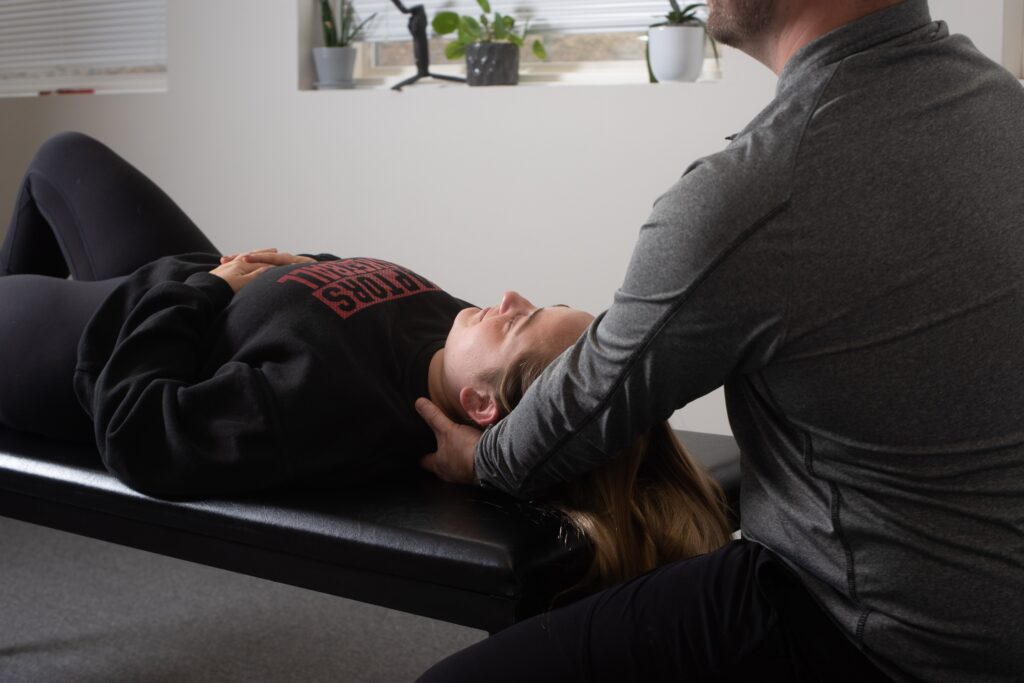
Once the big restrictions are cleared and the jaw still is not opening and closing well, I assess the TMJ from the outside. I palpate the condyles as you open and close, and I feel which side is not moving the way it should. Both joints are meant to move together, so when one lags, that tells me where the restriction lives. This is the kind of read I am describing when I talk about what my hands are feeling for during an assessment, and it is closely tied to the neck tension that keeps coming back.
The important thing is how I work. Because the jaw pain is usually very sensitive and often painful, I work TO it, not AT it. The goal is to create space and improve the movement leading into the joint, rather than forcing the joint itself. The touch is light. Sometimes I will create a gentle wedge with a finger as you open and close, guiding the joint back onto a better path, using the jaw or the ear as fix points and levers to address the restriction. This is the opposite of getting cranked on, and it is exactly why going gentle and indirect is what finally lets the jaw let go and the jaw pain can reduce.
The stress connection, explained properly
People love to say they hold their stress in their jaw, in their traps, or their neck. I understand why it feels that way, but the jaw pain is not a storage tank for stress.
Here is what actually happens. Stress changes how you breathe and how you hold yourself. You exhale and brace, you hunch, you fold forward. And we just covered what folding forward does to your head carriage and the front of your neck. So your body, now stuck in that posture, subconsciously clenches, because clenching helps it manage the pull working against the jaw.
It is not because you are doing something wrong. You are not chewing incorrectly or failing some posture test. It is a whole body pattern that simply shows up loudest at the jaw, because the jaw pain is stemming from a sensitive joint at the end of the chain.
When to see a dentist or doctor first
A quick honest word on safety. If you have dental issues, pain inside the mouth, or a sudden severely painful jaw that came out of nowhere with no good explanation, see your dentist or doctor first, and treat it as urgent. Locking that will not release, a sudden change in your bite, or swelling also belong in that category. Osteopathy is for the mechanical, movement-driven jaw tension, not for an infection or a dental emergency.
With that said, once those things are ruled out, osteopathic treatment is often a less invasive and less expensive place to start than shelling out on a series of dental accessories.
What to expect, and the one thing to walk away with
For chronic, mechanically driven jaw pain, the picture is encouraging. Once the movement of the jaw improves, the jaw issue tends to settle. Within three to four treatments we can usually free up a large amount of the restriction. At the very least your head should feel more relaxed and there should be less stress running through the jaw. Everyone is different, but you should see noticeable and steady improvement.
The one thing I want you to walk out understanding is the thing you did not believe walking in. Your jaw is probably not broken. It is the sensitive joint at the end of a long chain, doing its best to cope with tension set somewhere else. Give that tension somewhere to go, and the jaw pain stops having to fight.
Book an appointment
If your jaw has been clicking, tightening, or aching and the night guard did not solve it, that is exactly the kind of pattern I look at as a Mississauga osteopath.
You can book at our Mississauga clinic or book in Burlington
No referral required. Initial $110, follow-up $85.