
Hip Pain in Mississauga: 5 Causes & Discover How Osteopathy Treats It
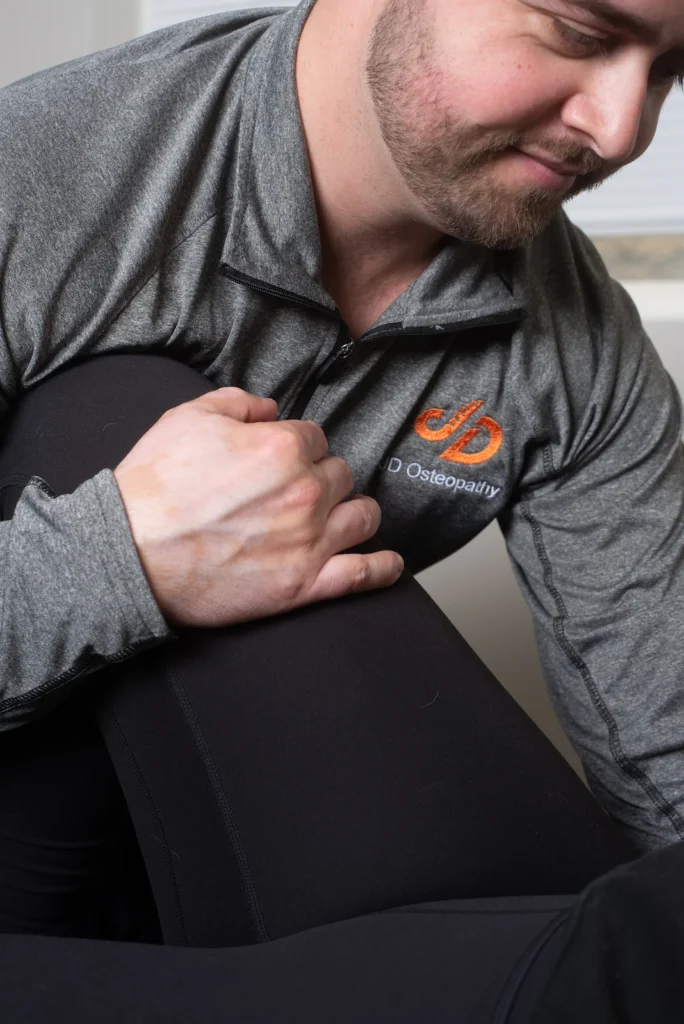
Hip pain is one of those complaints that tends to be lumped into a single category when in reality it’s one of the most anatomically complex presentations we see at our Mississauga clinic. The hip is a deep ball-and-socket joint surrounded by layers of muscle, fascia, and bursa, crossed by major nerves and blood vessels, and mechanically linked to both the lumbar spine above and the knee below. When something goes wrong in or around the hip, the origin of the problem is frequently somewhere other than where the pain is felt.
This post covers what’s actually happening in the hip when it hurts, the most common presentations we see in Mississauga patients, and why an osteopathic approach to hip pain tends to produce more lasting results than treatments focused only on the joint itself.
The Hip’s Role in the Body
The hip joint is one of the most load-bearing structures in the body. Every step you take transfers the full weight of your upper body through the hip – and when you factor in running, stairs, or carrying anything in your arms, the forces through the joint multiply considerably. The hip also serves as the primary hinge between your trunk and your lower limb, meaning it’s involved in virtually every movement you make throughout the day.
For the hip to function well, several things need to be true simultaneously: the joint itself needs adequate mobility, the surrounding musculature – gluteal muscles, hip flexors, deep rotators – needs to be relaxed and not constantly lengthened and stretched like you may think. These muscles, just like all muscles are responsive, and reactive to what happens with the sacrum (the large anchoring spinal bone also known as the tailbone), and the rest of the pelvis.
When your body turns, so does your spine and everything else that may be attached. Sometimes what may feel like a hip problem is actually your body’s best attempt at balancing you out.
Drag the slider — pull one rein and watch what happens to the other side.
Move the Slider above to see the relationship of the hip when one side contracts and/or one side lengthens.
It needs to be stable and symmetrical, and the lumbar spine above needs to be moving freely. When any one of these conditions breaks down, the others compensate - and compensation is where both pain and dysfunction develop.
Common Hip Pain Presentations We See in Mississauga
Greater trochanteric pain (lateral hip pain) Pain on the outer side of the hip, sometimes radiating into the outer thigh, is one of the most common hip presentations in our clinic. It's often described as a deep ache that worsens with lying on the affected side, crossing the legs, or climbing stairs. It's frequently misdiagnosed as bursitis - inflammation of the trochanteric bursa - but in most cases the primary driver is gluteal tendinopathy, meaning the tendons of the gluteus medius and minimus are under load they can't manage. This happens when hip mechanics are off, often due to pelvic imbalance or weakness in the hip abductors.
Deep gluteal syndrome and piriformis involvement Deep pain in the buttock that sometimes radiates into the back of the thigh is frequently attributed to sciatica - and sometimes it is. But deep gluteal syndrome, which involves compression of the sciatic nerve or other structures within the deep gluteal space, is increasingly recognised as a distinct condition. The piriformis muscle, which sits directly over the sciatic nerve in many people, can become restricted and contribute to this pattern. The distinction matters because the treatment is different - and treating it as lumbar disc sciatica when it's actually deep gluteal syndrome is one of the most common reasons hip and buttock pain doesn't resolve.
Hip flexor and iliopsoas restriction The iliopsoas - the primary hip flexor - runs from the lumbar vertebrae through the pelvis and attaches to the front of the femur. It's chronically shortened in anyone who sits for significant portions of the day, which in Mississauga's office-heavy, commuting-heavy population means the vast majority of our patients. A tight iliopsoas pulls the lumbar spine forward, creates anterior pelvic tilt, and loads the hip joint in extension. Patients often describe this as groin pain or a vague anterior hip ache, and it's almost never improved by rest because the posture that creates it is resumed the moment they return to normal activity.
Hip osteoarthritis Degenerative change in the hip joint is common in middle-aged and older Mississauga patients and produces a predictable pattern: groin pain that is worse in the morning, eases with movement, then returns after prolonged use. External rotation of the hip is typically the first movement to become restricted. While osteopathic treatment cannot reverse the structural changes of arthritis, it can significantly reduce the abnormal loading that makes arthritic hips symptomatic - by addressing gait compensations, lumbar stiffness, and the muscle imbalances that increase compressive force through the joint.
SI joint and pelvic contribution The sacroiliac joint - where the sacrum meets the ilium - refers pain into the buttock and outer hip in a pattern that closely mimics hip joint pathology. Distinguishing between true hip joint pain and SI joint referral requires a careful assessment, and getting that distinction wrong means treating the wrong structure. We see SI joint dysfunction contributing to hip pain presentations regularly, particularly in postpartum women and patients with a history of lower limb injury.
Why Hip Pain Tends to Become Persistent
The hip's role as a mechanical bridge between the spine and the lower limb means that when other areas in the spine do not move as well and are restricted or painful, the body compensates quickly and extensively. The lumbar spine picks up additional rotation if other areas that also rotate don't move well. The knee absorbs more load. The pelvis shifts weight to the opposite side. These compensations are initially helpful - they allow you to keep functioning. But over time they create their own problems, and the longer the original hip issue goes unaddressed, the more entrenched the compensatory patterns become.
Patients with chronic hip pain often arrive having treated the pain itself - with anti-inflammatories, physiotherapy focused on hip strengthening, or stretching - without anyone having assessed why the hip became restricted or overloaded in the first place. Finding that upstream cause is what separates treatment that works temporarily from treatment that produces lasting change.
How Osteopathy Approaches Hip Pain
At JD Osteopathy in Mississauga, a hip assessment evaluates the joint within its full mechanical context. We look at:
Hip joint mobility - range of motion in all directions, quality of movement, and end-range behaviour
Pelvic alignment and sacroiliac function - assessing whether the pelvis is contributing to how the hip is loading
Lumbar spine mechanics - looking at how restrictions above the hip are affecting its function
Gluteal and deep rotator tissue quality - assessing the muscles that control and stabilise the hip
Iliopsoas and hip flexor length - evaluating the influence of anterior hip tightness on joint mechanics
Lower limb chain - looking at the knee and ankle for compensatory patterns that are loading the hip from below
Assessing the neck's relationship in cochlear and visual balance - this may not seem related, but the hip plays a crucial role in stabilizing the neck and head, using the lumbar spine and pelvis through compensation. The hip has a lot of leverage...let's make sure it's not working harder than it needs to!
Treatment addresses what the assessment reveals across the whole chain - not just the hip joint. This typically includes joint mobilisation of the hip and pelvis, myofascial release of the surrounding musculature, lumbar and SI joint work where indicated, and specific treatment of the areas of the body that may influence the gluteal tendons or iliopsoas where these are primary drivers. Everyone is different so our approach will be tailored to you specifically. You can learn more about our approach here!
When to See a Doctor About Hip Pain
Most hip pain is mechanical and appropriate for osteopathic treatment. Seek medical assessment if you experience:
Hip pain following a significant fall or impact, particularly with an inability to bear weight
Sudden severe pain with a sensation of something giving way in the hip
Hip pain accompanied by fever, unexplained weight loss, or night pain that doesn't ease with position change
Groin pain in a child - hip pathology in children and adolescents requires prompt medical evaluation
Ready to Get Your Hip Properly Assessed?
If your neck pain keeps coming back - or if it’s been quietly building and you keep putting off dealing with it - an osteopathic assessment is a practical next step. Two people can walk in with identical symptoms and have completely different underlying causes. Finding yours is what determines whether treatment actually sticks.
JD Osteopathy is located at 5025 Orbitor Drive, Building 1, Unit 101 in Mississauga, and 3141 Walkers Line in Burlington. No referral required - you can book directly online. Find which JD Osteopathy location is closer to home.
Book Your Appointment in Mississauga
Book Your Appointment in Burlington
JD Osteopathy serves patients across Mississauga and Burlington. Our osteopathic practitioners hold a Master in the Practice of Osteopathic Manipulative Sciences (M.OMSc.) from the Canadian Academy of Osteopathy - the highest level of osteopathic education available in Ontario. Requirements involve over 4,200 hours of intensive education and clinical training. This ensures you receive care that is not only effective but also grounded in a deep understanding of anatomy, physiology, and the body's interconnected systems.
About the author: Dmitro Jovnyruk, M.OMSc. is an Osteopathic Manual Practitioner and Founder of JD Osteopathy with clinics in Mississauga and Burlington. His practice focuses on identifying the underlying mechanical causes of pain and discomfort through osteopathic assessment and treatment. Read Full Bio