Why You Feel Worse After Osteopathy (It’s Normal)
Is it Normal to Feel Worse After Osteopathy?
Yes, feeling worse after osteopathy can be normal, especially with a long-standing issue. A short flare of soreness for one to three days is usually a sign the body is adapting to change, not a sign something went wrong.
Healing isn’t always linear. Sometimes the path forward goes through a day or two of feeling worse before it comes out the other side.
Most people walk into their first osteopathy appointment hoping to feel better immediately. And often they do. But occasionally, particularly when dealing with something that’s been there for a while, patients leave feeling a bit more sore, a bit more aware of their body, or just different in a way they weren’t expecting. Then you go home and wonder if something went wrong and why you felt worse after osteopathy.
It didn’t. Here’s what’s actually happening and why understanding it changes everything about how you approach your recovery.
Why do you feel sore after an osteopathy treatment?
When you first hurt yourself whether it’s a car accident, a bad fall, a sports injury, or something as simple as sleeping wrong, your body responds immediately and intelligently. Blood rushes to the area. The tissue gets warm, swollen, and sore. Movement becomes restricted and uncomfortable.
This isn’t your body failing you. This is your body protecting you. The restriction in movement is deliberate, it’s your nervous system essentially putting a splint around the area to prevent further damage while the initial healing begins. The increased blood flow brings the resources needed to start repairing the tissue.
Most people recognise this as the acute phase of an injury. It’s uncomfortable, but it’s purposeful.
What Happens When an Injury Becomes Chronic?
Here’s where it gets interesting and where most people’s understanding of their own pain stops.
When that initial acute phase settles, the protective restriction often doesn’t fully go away. The area stays guarded. Movement in and around the injury remains limited. And over time, something shifts in the tissue itself.
Think of it like a riverbed that’s had its water flow reduced. Without the constant movement of fluid through an area, blood in, blood out, nutrients in, waste products out. As the tissue gradually loses its hydration and elasticity, it becomes stiff, dense, and rigid. If you’ve ever seen a dried-out riverbed or cracked desert ground, you already understand what happens to tissue that hasn’t been properly circulated for months or years. It loses its suppleness. It stops gliding the way it should.
At the joint level, this process goes further. The ligaments and joint capsule, the connective tissues that surround and stabilize every joint in your body begin to lay down fibrous tissue in response to the sustained restriction. This is your body’s way of reinforcing the status quo. It’s essentially saying: we haven’t been moving here for a long time, so let’s make that more permanent.
This is what we mean when we talk about a chronic injury. It’s not just something that’s been there a long time. It’s something the body has fundamentally adapted around compensating with other areas that move in similar directions, laying down fibrous reinforcement in the restricted zones, and reorganizing the entire system to function in a new, limited way.
The area that originally hurt may not even hurt anymore. But the restriction, the rigidity, and the compensatory patterns it created? Those are very much still there, and they’re affecting everything above and below them.
Why does releasing a restriction cause soreness?
This is the part nobody tells you before your first appointment.
When osteopathic treatment begins to restore movement to a chronically restricted area, the process essentially reverses. We’re unwinding the adaptation. We’re asking the body to let go of a pattern it has spent months or years reinforcing.
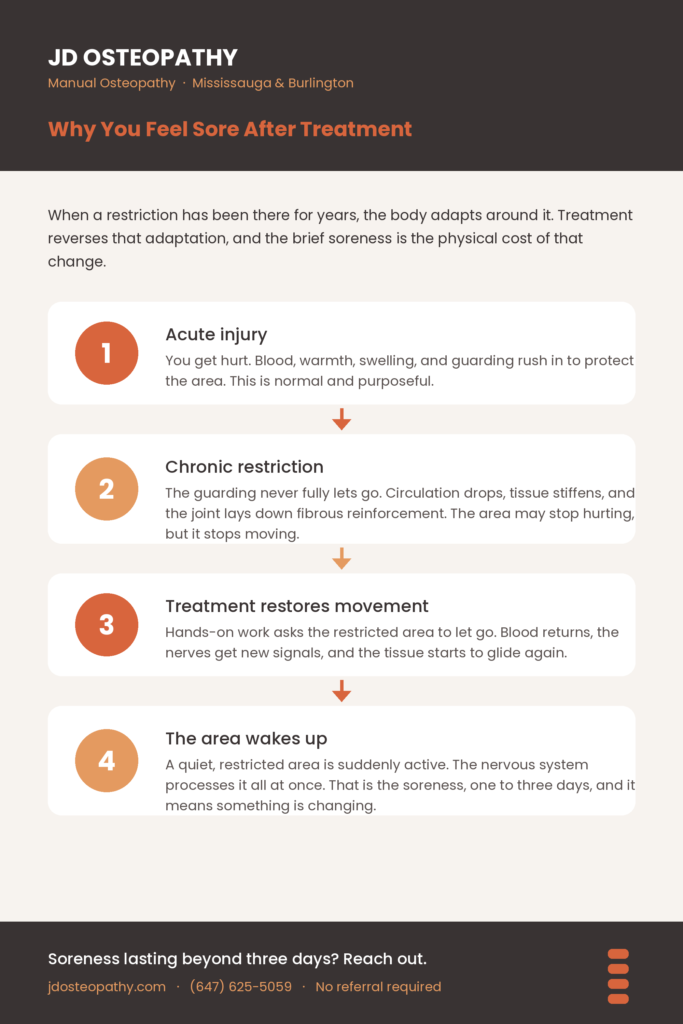
The sequence looks something like this:
Acute injury → Chronic restriction → Treatment removes the restriction → The area becomes acute again
That last step is the one that surprises people. When we restore movement to a joint or tissue that has been rigid for a long time, blood returns to the area properly, often for the first time in a significant period. The nerve supply to that area, which had adapted to the restricted position, now starts receiving different signals. The proprioceptors in the ligaments , the sensors that tell your nervous system where that joint is in space, relay to your brain that something has changed. The position is different. The movement is different. Everything that had settled into a quiet, restricted normal is suddenly active again.
Your nervous system registers all of this simultaneously. It’s not pain in the traditional sense, it’s more like a system that’s been quiet for a long time suddenly being asked to process a significant amount of new information all at once. The surrounding tissues, which had been compensating for the restriction, now need to recalibrate too.
The soreness you feel after treatment is the physical expression of that recalibration. You may have felt worse after osteopathy not because you’re getting worse, but because you’re changing. Change is uncomfortable, and the body tends to resist the change, holding on and resisting. It’s uncomfortable but should still be manageable and we understand that.
How long does soreness last after osteopathy?
For most patients dealing with chronic dysfunction, some degree of post-treatment awareness, soreness, fatigue, or a sense of things shifting is typical in the first couple of treatments. This usually settles within one to three days.
Movement helps. Gentle walking, normal daily activity, staying hydrated all of these support the recalibration process by keeping fluid moving through the tissues and giving the nervous system repeated, low-load input to integrate the changes made during treatment.
When should you be concerned after a treatment?
What we’re not aiming for is ongoing pain or dysfunction. The goal, as the body adjusts to its new normal, is progressive improvement, not just in the area we treated, but in how the whole system functions around it. Each subsequent treatment typically produces less post-treatment soreness as the body becomes less reactive to the changes being made.
If soreness persists beyond three days, or if something feels significantly different in a way that concerns you, always reach out. There’s no such thing as a question that’s too minor when it comes to how your body is responding to treatment. Sometimes the reason why you felt worse because we may have made too many changes at one time, and we want to ensure we are helping you and not making it worse.
Summary
- Right after treatment: mild soreness, tiredness, or a sense of things shifting
- Day 1 to 3: this settles for most people
- Beyond 3 days: reach out, it is worth a conversation
JD Osteopathy is located at 5025 Orbitor Drive, Building 1 – Suite 101 in Mississauga, and 3141 Walkers Line in Burlington. If you have questions about how your body is responding to treatment, we’re always happy to talk it through.
Book Your Appointment in Mississauga
Book Your Appointment in Burlington
JD Osteopathy serves patients across Mississauga and Burlington. Our osteopathic practitioners hold a Master in the Practice of Osteopathic Manipulative Sciences (M.OMSc.) from the Canadian Academy of Osteopathy – the highest level of osteopathic education available in Ontario. Requirements involve over 4,200 hours of intensive education and clinical training. This ensures you receive care that is not only effective but also grounded in a deep understanding of anatomy, physiology, and the body’s interconnected systems.
About the author: Dmitro Jovnyruk, M.OMSc. is an Osteopathic Manual Practitioner and Founder of JD Osteopathy with clinics in Mississauga and Burlington. His practice focuses on identifying the underlying mechanical causes of pain and discomfort through osteopathic assessment and treatment. Read Full Bio