The short version: A good massage therapist genuinely helps, which is why people go back. But tightness and pain are usually the body’s response to something else, and massage often relaxes the symptom without addressing what is driving it. So the relief is real but temporary, and the problem returns. Osteopathy asks a different question: why is this area tight in the first place, and what restriction elsewhere is forcing it to work overtime. Both have their place. Massage is excellent for whole-body relaxation and calming an overworked nervous system. Osteopathy is aimed at finding and releasing the cause of a pattern that keeps coming back.
If you have been getting massages for the same recurring problem and it keeps returning, this is worth reading. It is not that the massage is failing. It is that massage and osteopathy are answering two different questions.
What is the difference between an osteopath and a massage therapist?
An easy assumption is that osteopathy is just a fancy massage, especially if massage is the first hands-on treatment you have ever had. Most people default to what they know.
There is a second misconception worth clearing up first, because it is baked into the name. People hear “osteo” and assume osteopathy is only for bones and joints, with nothing to offer soft tissue. But “osteo” refers to structure. Bones earned that root because they are the structural framework of the body, not because osteopathy stops at bone. In practice, structure means anything anatomical: bones, muscles, fascia, organs, nerves, and blood vessels. The job is to find the restrictions in that anatomy and let the body heal and regulate, without over-emphasizing any single layer. What gets treated depends entirely on the patient in front of us.
What is the difference between osteopathy and massage in a session?
There is real overlap. Like any manual therapies, both involve stretching and moving the body, and both use hands-on soft-tissue work.
A registered massage therapist typically spends longer on one area and works primarily on soft tissue, using techniques like myofascial release and soft-tissue release. That focused time is part of what makes massage so good at what it does.
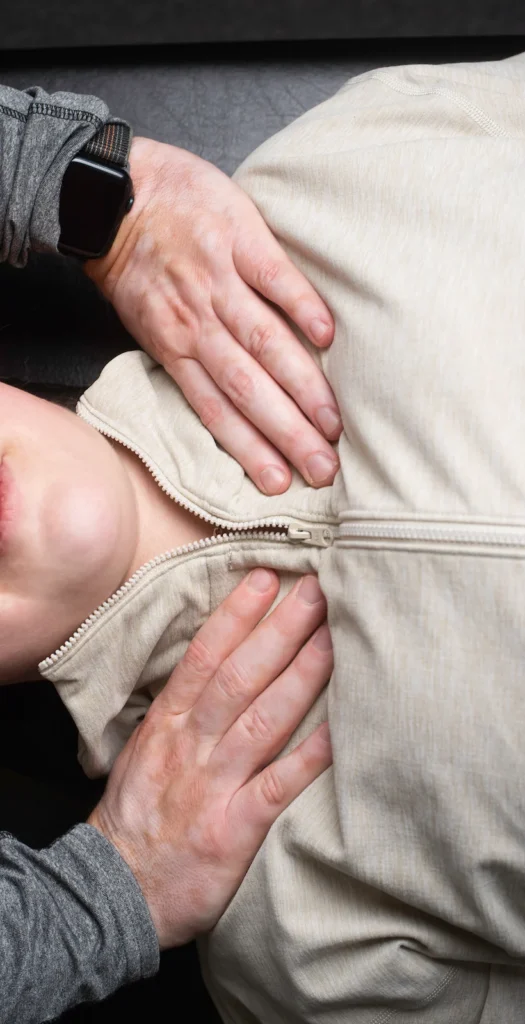
In osteopathy, we work across different barriers: myofascial, soft tissue, and joint movement through articulation and mobility. But the key difference is how the target is chosen. We decide which layer of tissue to work on based on anatomical feedback in real time: range of motion, and the temperature of the tissue, warmer where blood supply has increased, cooler where it has dropped relative to the area beside it. We are constantly comparing, and the treatment is built as we go, not set at the start.
A practical example. Someone comes in for their painful lower back. In a massage, the back and hips might be worked on exclusively, because that is where it hurts. In osteopathy, that same person might have their pelvis, neck, legs, and head assessed alongside the back before we get a clear answer about what is actually driving the pain.
Do osteopaths do massage?
Osteopathic treatment includes hands-on soft-tissue work, so parts of a session can feel similar to massage. The difference is not the technique, it is why and where it is applied. The soft-tissue work is chosen from what the body’s anatomy is telling us in the moment, and directed at the structures driving the problem, rather than worked as a full-body routine. So there is overlap in what your hands might feel, but the reasoning behind it is different.
Why does massage relief keep wearing off?
This is the heart of it, and it is not a criticism of massage.
Tightness and pain are usually a response, the body reacting to protect you or to compensate for something else. When a massage therapist works an area to desensitize and relax it, that can temporarily switch the response off. It feels great. But as soon as you go back to moving normally, the signal that caused the response in the first place is still there. So the pattern returns.
Part of why this happens: in massage, the patient largely dictates the treatment area. Your symptoms and where it hurts guide the session. That is reasonable, but subjective complaints can lead a practitioner toward the loudest area rather than the responsible one. The spot that hurts is often the spot working hardest, not the spot causing the problem.
A real pattern: the hamstring that will not loosen
Here is an example we see constantly. A patient has chronically tight hamstrings. No matter what they do, massage, stretching, they loosen briefly and then tighten right back up.
Here is why. The hamstring is often tight because the thigh and pelvis are pulling against a constant stretch it is being held in, trying to keep up with something above or below it. Say the spine is restricted in forward bending on one side. That stops the hip on that side from bending and rotating properly. So every time the person swings their leg forward, just to walk or sit, they stretch that hamstring. The body, trying to protect the tissue from being overstretched, contracts it, because a contraction shortens and guards the muscle. The more you stretch and manipulate it, the harder it has to work to hold on.
Stretching and massaging that hamstring directly is fighting the body’s own protection. In osteopathy, we ask why it is tight, and assess the surrounding structures, the spine, the pelvis, the hip, to find what is holding the pattern in place. Release that, and the hamstring no longer has a reason to guard. That is the difference between chasing the symptom and finding the cause.
When should you choose massage, and when osteopathy?
Both are valuable, and this is not a competition.
Choose massage therapy when:
- You want whole-body relaxation
- When you are overworked, physically run down
- Carrying a lot of stress
A good massage, especially one that is not so intense that it causes pain, is deeply therapeutic. The longer appointment lets the body settle into a genuinely calm state, which helps the nervous system recalibrate and gives tight muscles a chance to let go. For general recovery and stress, it is excellent.
Choose osteopathy when:
- Carrying a lot of stress a problem keeps coming back no matter how much you treat the painful spot
- When the relief never lasts
- When you want to find out why an area is tight rather than just quieting it down
Osteopathy goes after the restriction driving the pattern.
Plenty of people use both, massage to relax and recover, osteopathy to sort out why something keeps returning. If you are still weighing your options, how osteopathy compares to physiotherapy and chiropractic covers the rest of the field, and what the hands actually assess during a session shows what osteopathic treatment looks like in practice.
If your tightness or pain keeps coming back despite regular massage, it may be worth looking at what is holding the pattern in place. You can book directly at either location: Book in Mississauga or Book in Burlington. To learn more about how we work, visit manual osteopathy at JD Osteopathy. No referral required. Initial $110, follow-up $85.
About the author: Dmitro Jovnyruk, M.OMSc., is a manual osteopathic practitioner and the founder of JD Osteopathy, with clinics in Mississauga and Burlington. He trained at the Canadian Academy of Osteopathy in the classical, whole-body tradition of manual osteopathy.