
Why Your Osteopath Treats Other Areas, Not Just Where It Hurts
The short version: The spot that hurts is often not the thing causing the problem. A lot of the time it is the area that is working too hard, covering for something restricted somewhere else. We still settle the painful area down, but if we only ever work on the sore spot, the pain keeps coming back. An osteopath assesses the whole structure to find what is creating the problem pattern, and treats that. This is why an osteopath treats other areas and spend time on your hip when you came in for your neck.
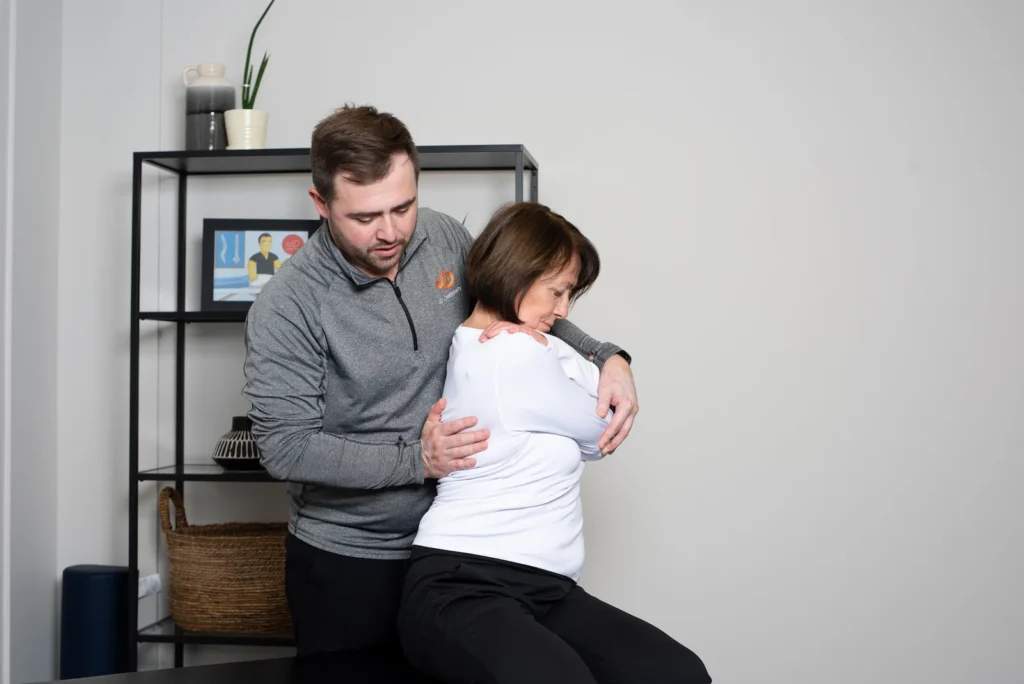
“Oh, by the way, it’s actually here”
The most common version of this happens partway through a treatment. I will be working somewhere away from the painful area, and the patient will say, oh, by the way, it’s actually here, as if I had forgotten where they were complaining.
I try to get ahead of that during the intake. I tell people early that I may end up treating in other areas, and I explain why. We have to assess everything and see all the connections to the area that is bothering them. If I find something restricted that is related to their troubled area, I want to address it, especially if it is a higher priority or has much more influence on the rest of the structure and the overall movement pattern.
So when the hands move away from the sore spot, it is not because the complaint was forgotten. It is because the complaint is being taken seriously enough to look for what is feeding it.
The painful spot is usually working too hard
The painful spot is not always the problem, because a lot of the time that spot is working too hard or overreacting. We do prioritise settling it down so it is not screaming at you. What we try not to do is linger there, prodding away at it, when something else is creating the response in the first place.
Here is the pattern. Areas that can move a lot have more of a tendency to overreact, because they are the ones being asked to do more work. Areas that can move will move, almost to a fault.
A good example is the neck. A lot of the time, neck symptoms are being driven by the lower back. The cervical spine and the lumbar spine are both backward curves, and both are built mostly for extension, so they tend to do very similar things. When you sit for a long stretch and your lumbar spine rounds into flexion, your neck tends to follow. In between those two curves sits the thorax, and the ribs have to make up for the lower back going forward, so the mid back drifts backward.
To keep your eyes and ears level with the horizon, the head then overcorrects and travels forward. That is why the neck and the lower back so often mirror each other. The neck restriction, the ache, the stiffness, is the head working overtime to keep you looking level.
That is also why neck pain so often keeps coming back when only the neck gets attention. If you want the longer version of that story, it is the same idea behind why neck pain keeps coming back.
Everything has to be explainable
I cannot justify a treatment if there is no anatomical connection behind it. That is built into how osteopathy works. One of its core principles is that structure and function are interrelated. Structure is the anatomy. Function is the physiology. Your feelings, the pain, the tightness, the symptoms, are the physiology. The anatomy is the explanation for why that is happening. If I cannot explain what I am doing through the anatomy, I should not be doing it.
Take the jaw and the pelvis, which sound completely unrelated. If I find a jaw issue, a neck issue, and a pelvic issue, I have to look for what connects the pelvis to the jaw, because there is a lot of space in between. Part of the work is filling in that void so the whole picture makes sense.
Sometimes it does not make sense at first. Sometimes a connection only becomes clear once we get other things moving and clear some of the smoke. Once a few restrictions are out of the way, the body starts to move more in unison, and the errors that are left show up more cleanly.
Why the sore spot keeps coming back
A lot of people come in having had the same spot worked on over and over. That is usually not because the previous practitioner was bad or not doing their job. Most of the time, it is that the sore spot was the only place anyone was looking.
The spot is sore, and yes, there is an error there. But for a change to hold, the body needs a way to support itself around that area. If that spot was working to create stability, and you take the tension off it without addressing the areas that were making it pull and counterbalance, it has no choice but to go back to pulling. The spot is important to treat. It is just as important to address everything attaching to it.
You never move in singularities. You cannot move only your L1 or L2 vertebra. You can try, but the moment you move any part of the spine, the whole spine has to come along. That is how the body works in real life, and that is how osteopathy approaches it. We are trying to get everything moving well together, in unison.
The way I picture it is a Jenga tower that is unstable but still standing. A lot of pieces have been pulled out and restacked in an abnormal way, and it stays upright as organised chaos, right up until you remove the one piece holding it together. Then it falls. So we are not just checking whether the top looks good or the bottom looks good. We are trying to work out what part of the tower needs the most support, and we often rebalance from the base so the whole thing does not tip over.
The painful area can be like the worker who has been pulling a double shift for months. The answer is not to keep beating on the tired worker. It is to share the load with everything around it.
Finding the real source takes more than one look
The real source is not always easy to find, and the real answer is that you do not usually find it in the first assessment. You can form a good hypothesis, but that hypothesis changes as you treat.
Osteopathy relies on a running diagnosis. We assess while we treat, then reassess after we make a change, and the information keeps revising the original picture. We are not trying to nail the cause in the first five minutes. We are deducing what is not the cause, by removing restrictions we think are influencing the overall pattern and watching how the body responds.
We want to find the real driver as soon as possible, but it does not always show itself right away. That is why continuous assessment during the treatment matters so much. It is what lets us give you the best quality of care, and it is a big part of what an osteopath is feeling for the whole time their hands are on you.
It is also part of why a body can feel different, or even briefly worse, after a session. It is adjusting to a new way of sharing the load.
When the painful area is the problem
None of this means the painful area is never the right place to work. Sometimes it is exactly where we need to be, especially with something acute.
Picture a sudden, angry neck that you cannot turn in any direction. In that moment, there is no sense in going after the lower back. The body is in a stressed, protective state, and the first job is to calm things down and reduce the irritation on the nervous system. Once it settles, there is room to look further. So it is very much patient to patient, and it depends on whether things are acute and reactive or chronic and stiff. Every treatment has its own goal.
One thing worth saying plainly. If pain comes on suddenly and severely, follows an injury, or comes with other warning signs, get it checked by a doctor first. Settling tissue down is one thing. Ruling out something that needs medical attention is another, and that comes first.
If you want the bigger picture of how we assess the body as a whole rather than in parts, that is the heart of our approach to treatment.
An Osteopath treats other areas because they care about your long term health
When there is a painful spot or long-term problem area, we can only think about the “Now” because pain is programmed to be made aware of so you can address it. The problem is, when you leave the office, the body has to do the healing, it’s not the practitioner who fixes you. Their job is to give your body the best chance to heal and self-regulate.
With that said, the choices that are made in osteopathy is dictated by what the body, the anatomy, tells us. So if your body is telling the osteopath that the lower back is unable to backward bend, and your painful neck is moving relatively well in comparison to lower back, the osteopath has reason to fix the mechanical restriction of the lower back to take tension off the spine.
Sometimes its a temporary goal and sometimes you gotta take the long way around so not to overwhelm the area with manipulation. For your longterm health, that’s the best decision, so you can help yourself not just temporarily, but so your body has the means to help itself after the fact.
Book an appointment
If you want a Mississauga osteopath who looks at the whole structure instead of only the spot that hurts, we would be glad to help.
Book your appointment in Mississauga
Book your appointment in Burlington
No referral required. Initial $110, follow-up $85.
JD Osteopathy serves patients across Mississauga and Burlington. Our osteopathic practitioners hold a Master in the Practice of Osteopathic Manipulative Sciences (M.OMSc.) from the Canadian Academy of Osteopathy, the highest level of osteopathic education available in Ontario.
About the author: Dmitro Jovnyruk, M.OMSc. is an Osteopathic Manual Practitioner and Founder of JD Osteopathy with clinics in Mississauga and Burlington. His practice focuses on identifying the underlying mechanical causes of pain and discomfort through osteopathic assessment and treatment. Read Full Bio
2 Comments
Comments are closed.