
Neck Pain in Mississauga: Why It Keeps Coming Back and What Osteopathy Actually Does About It
Neck pain is one of the most common reasons people come into our Mississauga clinic, and it’s also one of the conditions where people tend to wait the longest before seeking help. Most people assume it’ll just go away on its own...but what if it doesn’t?
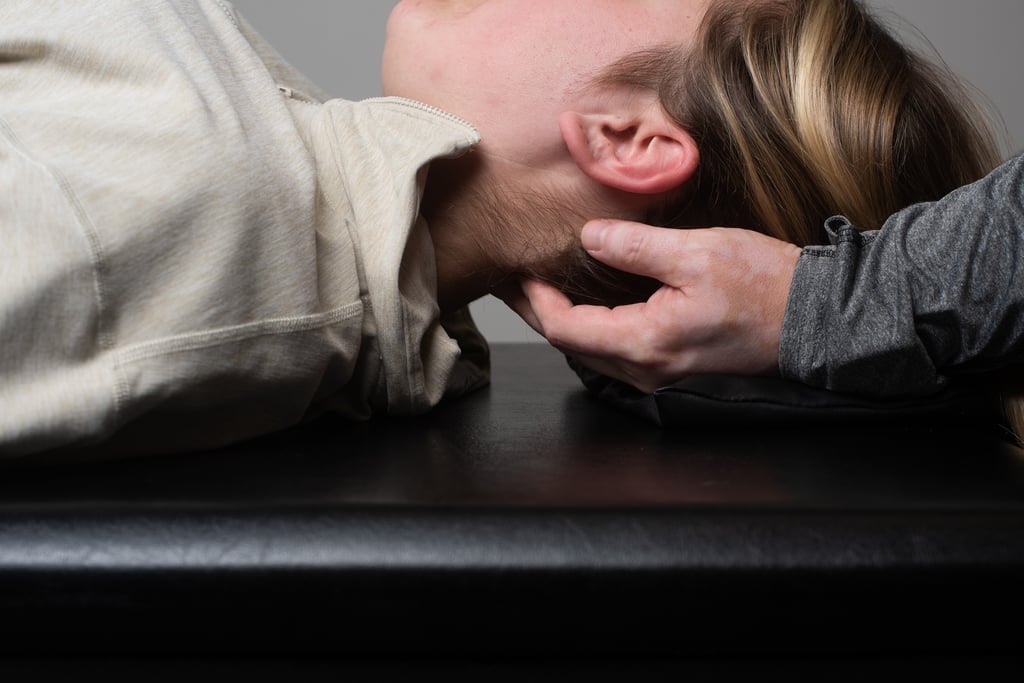
If you’ve ever woken up with a stiff neck that took days to loosen up, or noticed that tightness creeping up from your shoulders into the base of your skull by mid-afternoon — you’re not alone. Neck pain is one of the most common reasons people come into our Mississauga clinic, and it’s also one of the conditions where people tend to wait the longest before seeking help.
Most people assume it’ll just go away on its own. Sometimes it does. But for a significant portion of Mississauga patients, it keeps coming back — and there’s a mechanical reason for that.
Why Neck Pain Is So Common in Mississauga Specifically
This isn’t just a generic health complaint. The lifestyle patterns that are particularly common in Mississauga — long commutes on the 401 or 403, hours at a desk, looking down at a phone, working from home on a laptop that’s never quite at the right height — create a very specific and very consistent set of mechanical problems in the cervical spine.
When your head sits forward of your shoulders for extended periods, the muscles at the back of your neck are working overtime just to hold your head up. Your head weighs approximately 10–12 pounds in a neutral position. For every inch it drifts forward, the effective load on your neck roughly doubles. Over the course of a workday, that’s an enormous amount of cumulative strain on the cervical joints, discs, and surrounding soft tissue.
This is why neck pain so often doesn’t feel like an injury — it doesn’t come from a single moment. It accumulates quietly until one day you turn your head to change lanes and something catches.
What’s Actually Happening in the Neck When It Hurts
The cervical spine is made up of seven vertebrae stacked from the base of your skull down to the top of your thoracic spine. It’s designed to balance mobility with stability — you need to be able to look in every direction without restriction, while the spine simultaneously protects the spinal cord running through it.
When this system is under repetitive strain, several things typically happen:
Joint restriction in the cervical and upper thoracic spine. Individual vertebral segments lose their normal range of motion — not dramatically, but enough that the surrounding muscles have to compensate. Those compensating muscles fatigue, tighten, and eventually become the source of the familiar ache at the base of the skull or across the tops of the shoulders.
Loss of thoracic mobility. This one is frequently missed. The upper and mid thoracic spine — the area between your shoulder blades — is supposed to extend and rotate freely. When it becomes stiff, which it almost always does in people who sit for long periods, the cervical spine is forced to absorb movements it wasn’t designed to handle alone. Treating the neck without addressing thoracic restriction is one of the main reasons neck pain recurs.
Fascial and soft tissue tension. The muscles and connective tissue running through the neck, shoulders, and upper chest form an interconnected web. Tightness in the pectorals, the scalenes, or the suboccipital muscles at the base of the skull can all contribute to cervical restriction — and none of these structures are in the neck itself.
Disc and nerve involvement. In more advanced cases, chronic compression and poor mechanics can affect the cervical discs and begin to irritate the nerve roots that exit the spine at each level. This can produce symptoms beyond local neck pain — referral into the shoulder, arm, or hand, tingling in the fingers, or headaches originating at the base of the skull.
Why Neck Pain Tends to Come Back
The pattern we see repeatedly at our clinic goes something like this: the neck flares up, the patient rests for a few days, the pain settles, they go back to their normal routine — and four to six weeks later, it happens again.
This cycle happens because rest addresses the symptom without addressing the cause. The underlying joint restriction, the forward head posture, the thoracic stiffness — none of these change with rest. The neck quiets down temporarily, but the same mechanical conditions are still there, waiting for the next provocative moment.
Chronic neck pain can also begin to sensitize the nervous system over time, making the area progressively more reactive. The longer these patterns go unaddressed, the more entrenched they become — which is why the person who’s had neck pain on and off for ten years often takes longer to respond to treatment than someone who addresses it early.
How Osteopathy Approaches Neck Pain
At JD Osteopathy in Mississauga, we treat neck pain the same way we approach every condition: by assessing the whole body to understand what’s actually driving the problem, not just where it hurts.
A typical osteopathic assessment for neck pain involves evaluating:
∙Cervical joint mobility — identifying which segments are restricted and how they’re affecting the surrounding structures
∙Upper and mid thoracic extension and rotation — because thoracic stiffness is almost always part of the picture
∙Shoulder girdle mechanics — looking at how the shoulder blades are moving and whether the surrounding musculature is contributing to cervical load. We discuss the shoulder and related issues in depth here.
∙Postural patterns through the whole spine — the position of the pelvis and lower back affects the upper spine more than most people realize. The lumbar spine and pelvis play a big role in the foundational support mechanically for the upper body. We need to identify whether the neck is working too hard to counter balance the deficiencies in the lumbar spine and sacrum. We often see sciatica related issues in the past or present develop neck issues and vice versa. Check out our sciatica article here if you’re wanted to learn more.
∙Soft tissue quality in the neck, chest, and upper back — identifying where fascial restrictions and muscle tension are pulling the system out of balance
Treatment is hands-on and typically includes joint mobilization and articulation of the cervical and thoracic spine, myofascial release of the surrounding musculature, soft tissue work through the suboccipital region and scalenes, and where relevant, postural guidance on how to modify your workspace or movement habits to reduce the load going forward.
The goal isn’t just to make the neck feel better for a few days. It’s to restore the mechanical balance that was allowing the problem to develop in the first place.
Ready to Get Your Neck Properly Assessed?
If your neck pain keeps coming back — or if it’s been quietly building and you keep putting off dealing with it — an osteopathic assessment is a practical next step. Two people can walk in with identical symptoms and have completely different underlying causes. Finding yours is what determines whether treatment actually sticks.
JD Osteopathy is located at 5025 Orbitor Drive, Building 1, Unit 101 in Mississauga, and 3141 Walkers Line in Burlington. No referral required — you can book directly online.
JD Osteopathy serves patients across Mississauga and Burlington. Our osteopathic practitioners hold a Master in the Practice of Osteopathic Manipulative Sciences (M.OMSc.) from the Canadian Academy of Osteopathy — the highest level of osteopathic education available in Ontario.
When to Take Neck Pain More Seriously
Most neck pain is mechanical and responds well to osteopathic treatment. However, there are symptoms that warrant prompt medical attention before pursuing manual therapy:
∙ Neck pain following a significant impact, fall, or accident
∙ Numbness, tingling, or weakness radiating down the arm into the hand
∙ Severe headache of sudden onset accompanying neck pain
∙ Neck pain accompanied by fever, unexplained weight loss, or night pain that doesn’t ease with position change
These presentations can indicate involvement that goes beyond mechanics and should be assessed medically first.