
Shoulder Pain in Mississauga: Why It Keeps Coming Back
Shoulder pain is one of those complaints that people tend to manage around for a long time before actually addressing it. You modify how you reach. You stop sleeping on that side. You avoid certain movements at the gym or on the golf course. And for a while, that works — until it doesn’t, and the restriction has become significant enough that it’s affecting more than just the original irritation.
At our Mississauga clinic, shoulder pain is one of the most frequent presentations we see, and it’s also one of the most commonly misunderstood. The shoulder is an extraordinarily mobile joint, and that mobility comes at the expense of inherent stability. It depends on the structures around it — the rotator cuff, the rib cage, the thoracic spine, the neck — to function well. When any of those structures isn’t moving properly, the shoulder compensates, and compensation over time produces pain.
This is why treating the shoulder in isolation so often produces incomplete results.
What Makes the Shoulder Complex
The shoulder is not a single joint — it’s a system of four interconnected joints that need to work in coordinated sequence for normal arm movement to occur. The glenohumeral joint (the ball-and-socket most people think of as “the shoulder”), the acromioclavicular joint, the sternoclavicular joint, and the scapulothoracic articulation — the movement of the shoulder blade on the rib cage — all contribute to what we perceive as shoulder range of motion.
For the arm to reach overhead, for example, the glenohumeral joint contributes roughly 120 degrees of that movement, and the scapula rotating on the rib cage contributes the remaining 60. If the rib cage is stiff, or the thoracic spine is restricted in extension and rotation, the scapula can’t move freely — and the glenohumeral joint has to compensate by moving further than it’s designed to. That excess demand on the ball-and-socket is a common mechanism for rotator cuff irritation, impingement, and long-term tissue breakdown.
Common Causes of Shoulder Pain We See in Mississauga Patients
Rotator cuff irritation and impingement
Impingement occurs when the tendons of the rotator cuff are compressed in the space beneath the acromion — a bony projection of the shoulder blade. It typically produces pain with overhead reaching and lying on the affected side. What’s often missed is that impingement is frequently a mechanics problem, not a tissue problem. If the scapula isn’t rotating upward properly due to thoracic stiffness or poor rib cage mobility, the sub-acromial space narrows. Treating only the local shoulder without addressing thoracic mechanics is why impingement tends to recur.
Frozen shoulder (adhesive capsulitis)
Frozen shoulder is a progressive stiffening of the joint capsule that significantly reduces range of motion in multiple directions. It’s most common in people over 40 and often develops after a period of reduced shoulder use following an injury or illness. True frozen shoulder is a distinct process that responds to specific osteopathic techniques targeting the capsule and the surrounding fascial structures — and importantly, it takes time. Understanding the stage of the condition matters as much as the treatment.
Rotator cuff tears
Partial or full rotator cuff tears produce pain and weakness, particularly with resisted external rotation and reaching overhead. While significant tears may ultimately require surgical intervention, many partial tears and a surprising number of full-thickness tears respond well to conservative management — and osteopathy can play a meaningful role in restoring mechanics and reducing load on the healing tissue.
Referred pain from the cervical spine and thoracic outlet
This is the most commonly missed contributor to shoulder pain. The nerves that supply the shoulder and arm originate in the cervical spine. Restriction or irritation in the lower cervical and upper thoracic spine can refer pain directly into the shoulder in a pattern that mimics rotator cuff pathology. Patients who have been told they have a shoulder problem — and treated accordingly — without lasting results sometimes find that the actual source is much further up the chain.
Postural and thoracic contribution
People who sit for long hours — which describes a large portion of Mississauga’s working population — develop a predictable pattern of thoracic kyphosis, forward head posture, and anterior shoulder rounding. This position loads the rotator cuff unevenly, reduces the sub-acromial space, and gradually restricts the shoulder’s ability to reach its full overhead range. The pain that eventually develops in the shoulder is the end result of a postural pattern, not a shoulder-specific injury.
Sports-Related Injury or Overuse
When you’re working hard to improve and training intensity is persistently high, we can see injuries to the shoulder, especially at the acromial-clavicular joint (AC joint) at the outer part of the collarbone. Since it is the most mobile joint in the body, it also has the unfortunate fate of being the most unstable…as stability and mobility have an opposite relationship. When a shoulder is already irritated, sports with impact swings like golf can further irritate not just the AC joint but the entire shoulder blade. If you’d like to learn more about golf-related injuries and how osteopathy can help, we talk at length about it here.)
Why Shoulder Pain Tends to Become Chronic
The shoulder’s mobility makes it resilient in the short term — it can compensate around restrictions for a long time before those compensations produce symptoms. But that same adaptability means that by the time pain appears, the underlying mechanics have usually been compromised for a while. The pain is often the last thing to develop, not the first.
Treating the pain without restoring the underlying mechanics leaves the compensatory pattern in place. The shoulder quiets down, you return to normal activity, the same demands are placed on the same compromised system — and the pain returns. This cycle is why shoulder pain has a reputation for being stubborn.
How Osteopathy Approaches Shoulder Pain
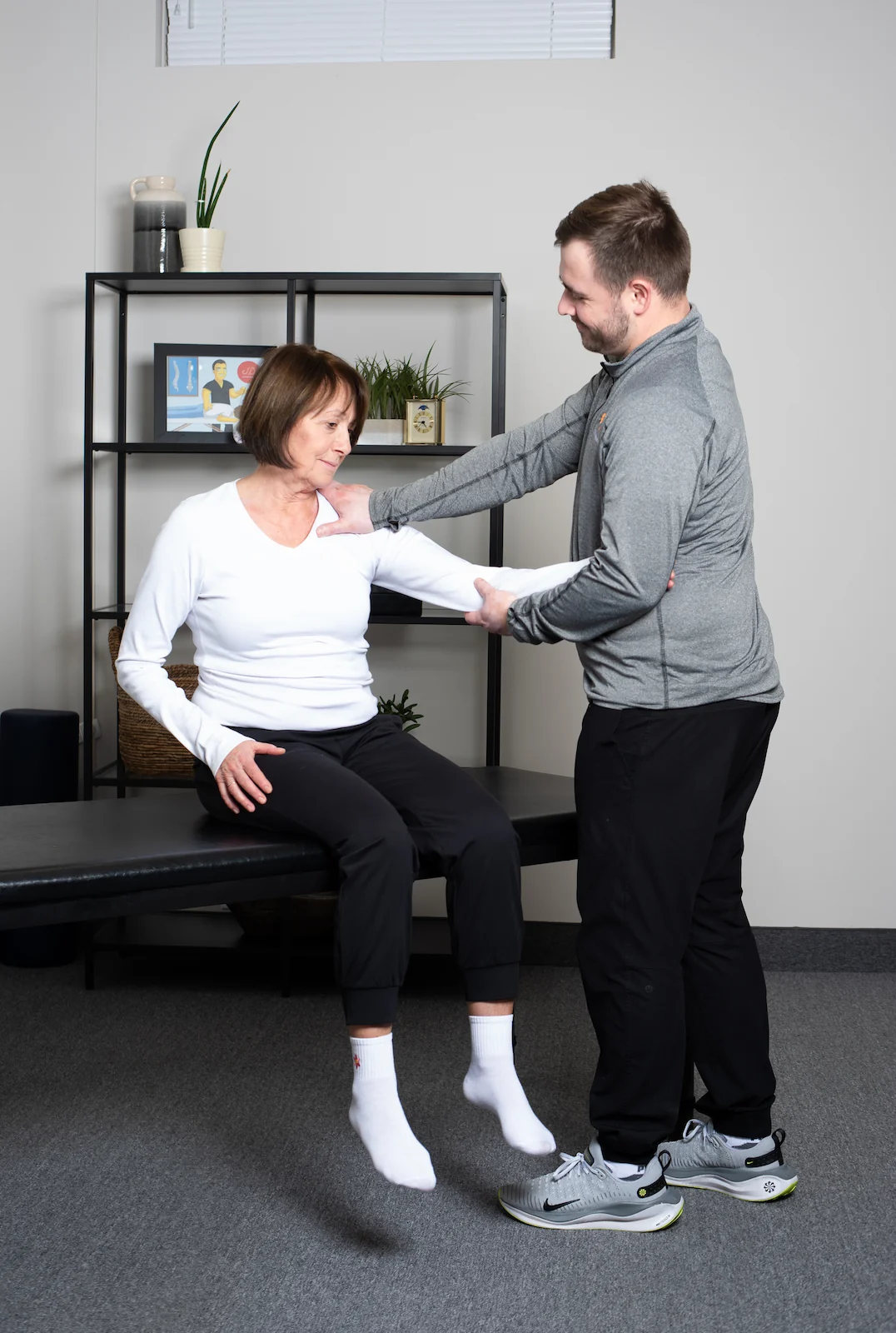
At JD Osteopathy in Mississauga, a shoulder assessment looks well beyond the joint itself. We evaluate:
∙Glenohumeral range of motion — comparing active and passive movement to understand what’s limiting range and where
∙Scapular mechanics and rib cage mobility — assessing whether the shoulder blade is moving freely or being constrained from below
∙Thoracic spine extension and rotation — because the thoracic spine is the foundation the shoulder sits on
∙Cervical spine and upper thoracic function — ruling out or addressing referred pain from the neck and thoracic outlet
∙Rotator cuff and surrounding tissue quality — palpating for restriction, asymmetry, and tissue changes
∙Whole-body mechanics — looking at how posture, the opposite shoulder, and the rib cage are contributing to the presentation
Treatment is hands-on and tailored to what the assessment reveals. Two people with the same shoulder complaint often need very different approaches — which is why the assessment comes before the treatment, not the other way around.
When to See a Doctor About Shoulder Pain
Most shoulder pain is mechanical and appropriate for osteopathic treatment. However, seek medical attention if you experience:
∙Sudden, severe shoulder pain following a fall or direct impact
∙Visible deformity or significant swelling
∙Complete inability to move the arm
∙Shoulder pain accompanied by chest tightness or shortness of breath — this can occasionally indicate cardiac involvement
∙Unexplained night pain that doesn’t change with position
These presentations require medical assessment before manual therapy is appropriate.
Ready to Find Out What’s Actually Going On With Your Shoulder?
If you’ve been dealing with leg pain, buttock pain, or that familiar burning sensation radiating down from your lower back, don’t wait for it to resolve on its own. The sooner the underlying cause is identified and addressed, the faster and more completely you’ll recover.
JD Osteopathy- Mississauga is located at 5025 Orbitor Drive, Building 1, Unit 101 in Mississauga. JD Osteopathy- Burlington is located at 3141 Walkers Line, Burlington.
You can book an initial assessment and follow-up appointment directly online — no referral required.
Book Your Appointment in Mississauga
JD Osteopathy serves patients across Mississauga and Burlington. Our osteopathic practitioners hold a Master in the Practice of Osteopathic Manipulative Sciences (M.OMSc.) from the Canadian Academy of Osteopathy – the highest level of osteopathic education available in Ontario. Requirements involve over 4,200 hours of intensive education and clinical training. This ensures you receive care that is not only effective but also grounded in a deep understanding of anatomy, physiology, and the body’s interconnected systems.
About the author: Dmitro Jovnyruk, M.OMSc. is an Osteopathic Manual Practitioner and Founder of JD Osteopathy with clinics in Mississauga and Burlington. His practice focuses on identifying the underlying mechanical causes of pain and discomfort through osteopathic assessment and treatment. Read Full Bio