
Sciatica in Mississauga: What’s Surprisingly Causing Your Leg Pain & How Osteopathy Helps
The Short Answer
Sciatica is a symptom not a diagnosis, it can come from a disc, the piriformis muscle, the SI joint, or accumulated postural strain. Treatment that works addresses the actual source rather than the nerve itself. Osteopathic assessment for sciatica in Mississauga at JD Osteopathy evaluates the whole body to find that source, and most patients with mechanical sciatica notice meaningful improvement within the first few sessions. If you experience loss of bladder or bowel control, progressive leg weakness, or sciatica following a trauma, seek medical attention before manual therapy.
If you’ve ever felt a sharp, burning, or shooting pain that starts in your lower back and travels down through your buttock and into your leg, sometimes all the way to your foot, then you already know how disruptive sciatica can be. It can make sitting at a desk unbearable, turn a short drive into an ordeal, and interrupt your sleep.
Sciatica is one of the most common complaints we see at our Mississauga clinic, and it’s also one of the most misunderstood. Many people assume that sciatica is a diagnosis in itself, or that it always comes from a disc problem. In reality, sciatica is a symptom and finding out why your sciatic nerve is being irritated is what determines whether your treatment actually works.
This post covers what sciatica actually is, the most common causes we see in Mississauga patients, why it often doesn’t resolve on its own, and how osteopathic treatment addresses it at the source.
Why Sciatica Often Doesn’t Resolve on Its Own
Sciatica treatment in Mississauga has a reputation for being stubborn, and for good reason. If the underlying mechanical cause isn’t addressed, the irritation to the nerve persists regardless of how much rest you take or how many anti-inflammatories you use.
Rest can quiet the symptoms temporarily, but the moment you return to the posture, movement pattern, or activity that provoked it, the pain returns. This cycle of relief and relapse is extremely common and leads many Mississauga patients to conclude that they simply have to “live with it.”
The problem is that chronic sciatic irritation can also begin to sensitize the nervous system over time, meaning the nerve becomes progressively more reactive to stimuli that wouldn’t normally provoke pain. The longer the underlying cause goes untreated, the more entrenched the pain pattern can become.
This is why early, targeted treatment matters.
What Is the Sciatic Nerve?
The sciatic nerve is the longest and widest nerve in the human body. It originates from several nerve roots in the lower lumbar spine (L4, L5) and sacrum (S1, S2, S3), bundles together, travels through the deep gluteal muscles, and runs all the way down the back of each leg to the foot.
Because it covers so much territory, irritation anywhere along its path can produce symptoms in seemingly unrelated areas. Pain or numbness in your calf doesn’t necessarily mean the problem is in your calf, it may be originating from your lower back, your sacrum, or even a tight muscle in your buttock compressing the nerve.
This is exactly why treating only where it hurts so often fails.
Common Causes of Sciatica in Mississauga Patients
Lumbar Disc Irritation One of the most frequently cited causes of sciatica is a herniated or bulging disc in the lower lumbar spine. When disc material presses against one of the nerve roots that feeds into the sciatic nerve, it produces the characteristic radiating leg pain. However, disc involvement is not the only cause, and it’s often not even the primary one. Proper assessment and treatment of the lower back is crucial for understanding the source of sciatica.
Piriformis Syndrome The piriformis is a small muscle deep in the gluteal region that the sciatic nerve either passes through or directly beneath, depending on the individual’s anatomy. When the piriformis becomes tight, inflamed, or restricted, due to prolonged sitting, hip imbalance, or pelvic misalignment, can compress the sciatic nerve and produce symptoms that are nearly identical to disc-related sciatica. This is called piriformis syndrome, and it’s frequently overlooked.
In a city like Mississauga, where long commutes and desk-based work are the norm, piriformis syndrome is remarkably common. Sitting for extended periods shortens the hip flexors, loads the piriformis unevenly, and gradually builds the conditions for nerve compression.
Sacroiliac Joint Dysfunction The sacroiliac (SI) joint, where the sacrum meets the pelvis, is another common but under-appreciated source of sciatic-type pain. Restriction or misalignment in the SI joint can irritate the nearby sciatic nerve roots and refer pain down the leg in a pattern that mimics disc herniation. Without examining the whole pelvis, this is easy to miss.
Postural and Spinal Compensation Patterns Sometimes sciatica develops not from a single injury but from a gradual accumulation of postural strain. An old ankle sprain, a minor knee issue, or a habit of sitting with your weight shifted to one side can, over months and years, create asymmetry through the pelvis and lumbar spine that eventually irritates the sciatic nerve. The original cause may be far removed from where the pain is felt.
How Osteopathy Approaches Sciatica
At JD Osteopathy in Mississauga, we don’t start by assuming we know the cause — we assess the whole body to find it. Two patients can walk in with identical symptoms and have completely different underlying causes. Treatment needs to reflect that.
A thorough osteopathic assessment for sciatica typically involves evaluating:
Lumbar spine mobility and joint restriction – identifying which segments are restricted and how that’s affecting the nerve roots
Pelvic alignment and sacroiliac joint function – assessing whether the pelvis is contributing to nerve compression
Hip and piriformis tissue quality – checking for tightness, asymmetry, or restrictions in the deep gluteal muscles
Lower limb mechanics – evaluating how the foot, knee, and hip are moving, since compensation patterns from below often drive problems above
Overall postural and spinal balance – looking for the bigger picture of how the body has adapted around the problem
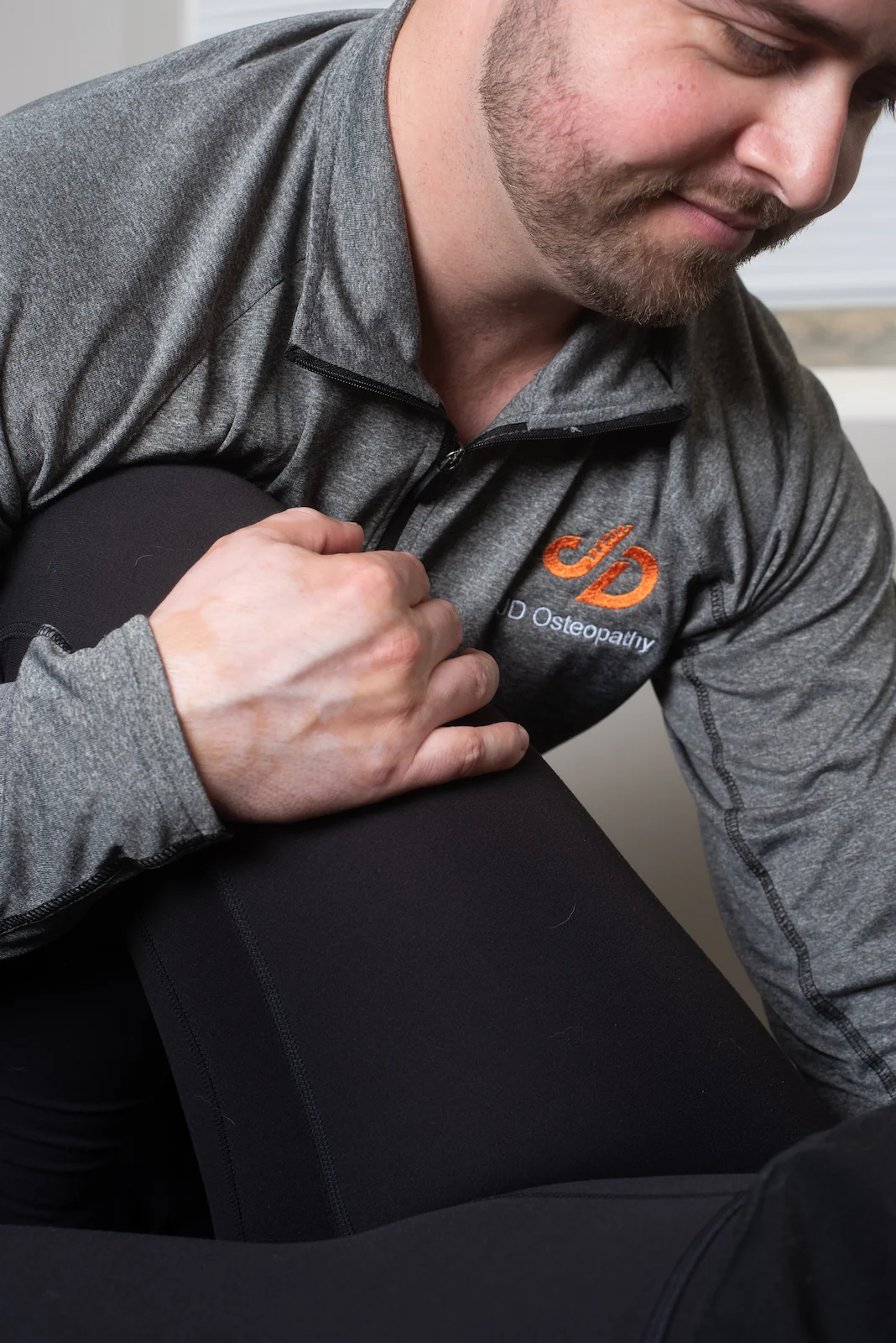
Treatment is hands-on and may include joint mobilization of the lumbar spine and pelvis, myofascial release of the piriformis and surrounding hip musculature, sacral and sacroiliac techniques, and work through the lower limb to address contributing factors. The goal is not just to relieve the nerve compression but to restore the structural balance that was allowing the compression to occur in the first place. There are definitely other forms of treatment you can consider depending on your specific case. We have broken down some alternatives comparing treatment modalities here.
When to See a Doctor
While osteopathy is highly effective for mechanical sciatica, there are situations that warrant urgent medical attention. You should seek immediate care if you experience:
Loss of bladder or bowel control
Progressive weakness in the leg or foot
Numbness in the inner thigh or groin area
Sciatica following a significant trauma like a fall or accident
These can be signs of more serious spinal involvement that requires medical investigation before manual treatment is appropriate.
What to Expect from Osteopathic Treatment for Sciatica
Many patients notice a meaningful reduction in leg pain within the first few sessions, though the timeline varies depending on how long the condition has been present and what’s causing it. Acute sciatica that developed recently often responds faster than a chronic pattern that has been building for years.
We typically recommend starting with four to five appointments spaced one to two weeks apart. You can make an appointment here. As symptoms improve, the interval between sessions increases. Our aim is always to get you to a point where you need us as little as possible, not to create a dependency on ongoing treatment.
Between sessions, we’ll often suggest specific movements or activity modifications to reinforce the changes made during treatment and avoid re-aggravating the nerve. Usually this is as simple as going for a walk to move the body which aids in circulation.
Ready to Get to the Bottom of Your Sciatica?
If you’ve been dealing with leg pain, buttock pain, or that familiar burning sensation radiating down from your lower back, don’t wait for it to resolve on its own. The sooner the underlying cause is identified and addressed, the faster and more completely you’ll recover.
JD Osteopathy- Mississauga is located at 5025 Orbitor Drive, Building 1 – Suite 101 in Mississauga. JD Osteopathy- Burlington is located at 3141 Walkers Line, Burlington.
You can book an initial assessment and follow-up appointment directly online — no referral required.
Book Your Appointment in Mississauga
Book Your Appointment in Burlington
JD Osteopathy serves patients across Mississauga and Burlington. Our osteopathic practitioners hold a Master in the Practice of Osteopathic Manipulative Sciences (M.OMSc.) from the Canadian Academy of Osteopathy – the highest level of osteopathic education available in Ontario. Requirements involve over 4,200 hours of intensive education and clinical training. This ensures you receive care that is not only effective but also grounded in a deep understanding of anatomy, physiology, and the body’s interconnected systems.
About the author: Dmitro Jovnyruk, M.OMSc. is an Osteopathic Manual Practitioner and Founder of JD Osteopathy with clinics in Mississauga and Burlington. His practice focuses on identifying the underlying mechanical causes of pain and discomfort through osteopathic assessment and treatment. Read Full Bio
One Comment
Comments are closed.