
Knee Pain in Mississauga: Why Rest Isn’t Fixing It
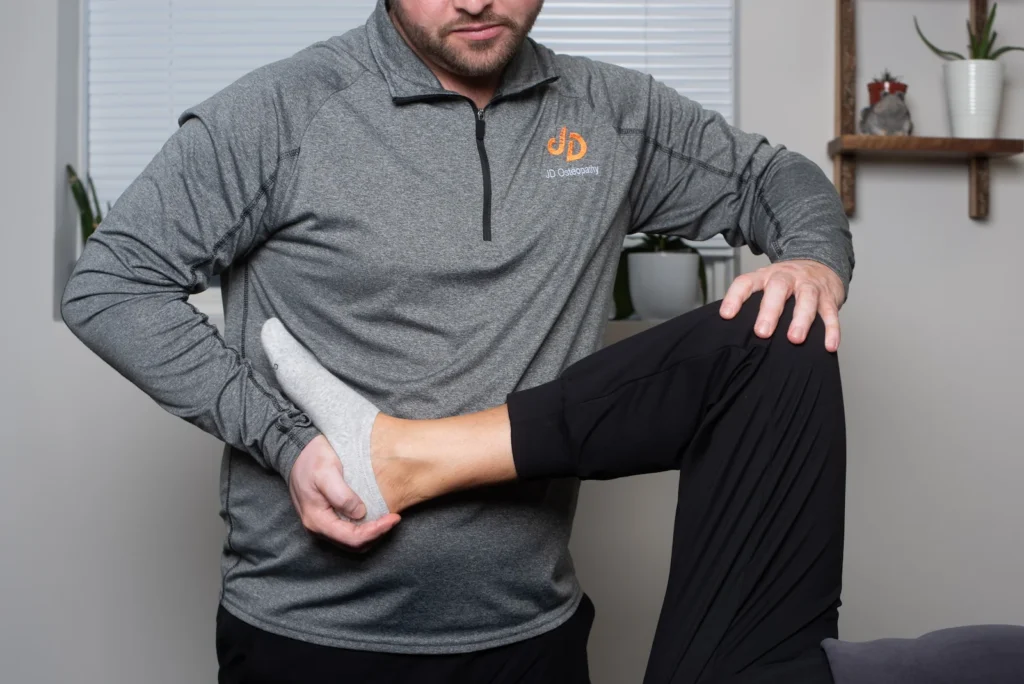
Knee pain in Mississauga is one of those conditions that people tend to wait out. You rest it for a week, it settles, you go back to your normal routine – walking, the gym, golf, whatever your week looks like – and within a short time it’s back. sometimes worse, sometimes just exactly the same, as if the week of rest accomplished nothing at all.
That cycle is extremely common, and there’s a straightforward mechanical reason for it. Rest reduces load on an irritated structure, which quiets the symptoms. But it doesn’t change why the structure was being overloaded in the first place. The moment normal activity resumes, the same forces are applied to the same knee through the same faulty mechanics, and the same irritation develops.
At our Mississauga clinic, knee pain is one of the most frequent lower limb complaints we see and treat – and it’s also one where the actual source of the problem is most often not the knee itself.
The Knee Is Caught in the Middle
The knee sits between two highly mobile joints – the hip above and the ankle below. Its primary job is to flex and extend, with a small degree of rotation. It is not designed to manage significant rotational or lateral forces on its own. When those forces arrive – as they do when the hip isn’t rotating properly, or when the foot is pronating excessively, or when the pelvis is tilted unevenly – the knee absorbs them. Over time, that absorption produces irritation in the structures that weren’t designed to handle it.
This is why knee pain so often doesn’t make sense in isolation. The knee hurts, but the knee didn’t cause the problem. It’s a victim of mechanics happening somewhere else in the chain.
Treating the knee without evaluating the hip, the foot, and the pelvis is like fixing a symptom without addressing its cause. It may provide temporary relief, but the mechanical conditions that produced the pain are still there.
Common Causes of Knee Pain We See in Mississauga Patients
Patellofemoral syndrome (runner’s knee)
Pain around or behind the kneecap, typically worse with prolonged sitting, going down stairs, or sustained activity. It’s caused by the patella tracking incorrectly in its groove as the knee bends and straightens – usually because the hip abductors and external rotators are weak or restricted, allowing the femur to rotate inward and pulling the kneecap off its optimal path. This is fundamentally a hip problem that presents as knee pain.
IT band syndrome
A sharp or burning pain on the outer side of the knee, common in runners and cyclists, caused by the iliotibial band repeatedly rolling over the lateral femoral condyle. The IT band itself is rarely the primary problem – it’s typically the result of too much strain from its neighbouring muscles, altered running mechanics, or pelvic imbalance that changes how load is distributed through the lower limb. A good thing to remember is the IT band is a ligamentous structure and does NOT contract so you shouldn’t strain the area too much.
In other words, it’s always important to not “roll it out” or put too much direct strain on the structure because you’re essentially punishing it for doing its job…resisting pull by stretching it when in fact it’s irritated because it’s too stretched. It’s equally important to see if treatment of the hip restriction or pelvis is creating that excessive pull and then presenting more at the knee attachment where it tends to move more.
Medial knee pain and pes anserine irritation
Pain on the inner side of the knee, often associated with excessive foot pronation, valgus knee alignment (knock-knee tendency), or hip restrictions of motion. The medial structures (inner part of the knee) – the MCL, the medial meniscus, and a collection of tendons that attach on the inner aspect – are placed under increased stress when the foot rolls inward and the knee drifts medially during weight-bearing.
Pes Anserine translates to “goose foot” because there’s 3 tendons attaching to the inner knee which resembles a goose foot. Each of the 3 muscles goes to one of three pelvic bones. Sartorius muscle to the ilium, the semitendonosis (hamstring) muscle to the ischium aka the sit-bone, and the gracillis muscle of the inner thigh to the pubic bone. All three muscles act as a tripod to stabilize the knee in relation to the pelvis.
Osteoarthritic knee pain
Knee osteoarthritis is extremely common in Mississauga’s middle-aged and older population, and it’s one of the areas where people most often assume nothing can be done short of a replacement. In reality, the mechanical contributors to arthritic knee pain – altered gait, hip stiffness, quadriceps inhibition, pelvic compensation – respond well to osteopathic treatment even when the underlying degeneration can’t be reversed. The goal isn’t to fix the joint structure. It’s to reduce the abnormal loading that’s making the degeneration symptomatic.
Post-injury compensation patterns
An old ankle sprain, a previous knee surgery, or even a hip injury can leave behind subtle compensation patterns that quietly alter how load is distributed through the knee for years afterward. Patients often present with knee pain that seems to have no clear cause – no recent injury, no specific incident. In many of these cases, the cause is a compensation pattern from something that happened a long time ago in a completely different part of the body.
In other instances improper lower limb mechanics from sports can lead to mechanical strain. In twisting sports such as golf, when your form isn’t optimal or it’s hard to turn, the forces through the knee aren’t evenly distributed, we can see persistent strain become a bigger issue.
The Hip-Knee-Foot Connection
At JD Osteopathy, we find that the three most common mechanical drivers of knee pain in Mississauga patients are:
Hip restriction – particularly of the gluteal muscles and hip external rotators. When the hip can’t properly control the femur during movement, the knee is forced into positions it isn’t equipped to handle. Proper movement of the hip takes load off the knee more effectively than any amount of direct knee treatment. Since the hip plays such a big role in movement in general, we go over the hip’s impact on pain all over the body in detail here.
Foot and ankle mechanics – excessive pronation (the foot rolling inward) changes the alignment of the entire lower limb, increasing stress on the medial structures of the knee. Similarly, a stiff ankle following an old sprain forces compensatory movement at the knee. The foot is the foundation – what happens there ripples upward.
Pelvic and lumbar mechanics – a rotated pelvis or “pelvic tilt”changes the how the hip and knee operate. It’s subtle, but over thousands of steps per day it accumulates into significant asymmetric loading. This is why people who work on their feet all day in Mississauga’s retail, healthcare, and corporate sectors are particularly prone to chronic, low-grade knee irritation.
Why Knee Pain Becomes Chronic
The pattern we see repeatedly is this: the knee flares, rest settles it, activity restarts the cycle. With each flare, the surrounding soft tissue becomes a little more reactive, the compensatory patterns around the knee become a little more ingrained, and the threshold for irritation gets a little lower.
Chronic knee pain is very often the result of the body progressively adapting around an unresolved mechanical problem. The longer it goes on, the more those adaptations need to be unwound – which is why addressing it early, or even before significant pain develops, produces faster and more complete results. If you’re interested in the mechanism of pain we explain why you get flare ups from old injuries and what we can do to help.
When to Seek Medical Attention for Knee Pain
Most knee pain is mechanical and appropriate for osteopathic assessment and treatment. Seek medical attention promptly if you experience:
∙Significant swelling following an acute injury, particularly if it developed rapidly
∙Inability to bear weight or a feeling that the knee is giving way
∙A locking or catching sensation inside the joint
∙Knee pain following a significant impact or trauma
∙Pain accompanied by redness, warmth, and fever, which may suggest infection or inflammatory joint disease
These presentations require imaging or medical assessment before manual therapy is appropriate.
How Osteopathy Approaches Knee Pain
A knee assessment at JD Osteopathy starts with the whole lower limb kinetic chain. We evaluate:
∙Knee joint mechanics – assessing the joint itself, the patella tracking, and the quality of the surrounding soft tissue
∙Hip mobility and strength – particularly external rotation and abduction, which have the strongest mechanical relationship with the knee
∙Foot and ankle mechanics – looking at pronation, ankle mobility, and any restriction from old injuries. Patients come in for treatment of the foot and ankle often in conjunction with knee pain at JD Osteopathy.
∙Pelvic alignment – assessing whether the foundation the lower limb operates from is level and symmetrical. Sciatica pain is often associated with pelvic movement dysfunctions.
∙Gait and movement patterns – watching how you actually move, because that tells us what the static assessment can’t. It’s ultimately crucial to identify how your knee moves in relation to the whole mechanism of walking and even running. Small errors multiply especially when we add load to the joint with compression from running on hard surfaces. If you experience pain from running, the source could be different than you think.
Treatment addresses what we find across the whole chain – not just the knee. This typically includes joint mobilization and soft tissue work at the hip and pelvis, myofascial release through the IT band and quadriceps, and specific work to restore ankle and foot mechanics where relevant. When the system above and below the knee is moving correctly, the knee itself is under significantly less abnormal load.
Ready to Get to the Bottom of Your Knee Pain?
If your knee has been limiting your activity – whether that’s walking Centennial Park trails, playing golf, training at the gym, or simply navigating a full day on your feet – an osteopathic assessment is a practical next step. The knee is rarely the whole story, and understanding what’s actually driving it is what determines whether treatment produces lasting results.
JD Osteopathy is located at 5025 Orbitor Drive, Building 1, Unit 101 in Mississauga, and 3141 Walkers Line in Burlington. No referral required.
Book Your Appointment in Mississauga
JD Osteopathy serves patients across Mississauga and Burlington. Our osteopathic practitioners hold a Master in the Practice of Osteopathic Manipulative Sciences (M.OMSc.) from the Canadian Academy of Osteopathy – the highest level of osteopathic education available in Ontario. Requirements involve over 4,200 hours of intensive education and clinical training. This ensures you receive care that is not only effective but also grounded in a deep understanding of anatomy, physiology, and the body’s interconnected systems.
About the author: Dmitro Jovnyruk, M.OMSc. is an Osteopathic Manual Practitioner and Founder of JD Osteopathy with clinics in Mississauga and Burlington. His practice focuses on identifying the underlying mechanical causes of pain and discomfort through osteopathic assessment and treatment. Read Full Bio
One Comment
Comments are closed.