Why Almost Every Pelvic Pain and Sacral Problem Starts Somewhere Else
The short version: The sacrum is the anchor at the base of your spine, and almost nothing in your body moves without it responding. That is exactly why pelvic and sacral pain is so often blamed on the wrong place. The painful area is usually the one working overtime to cover for a part that stopped pulling its weight, and that part can be your hip, your mid-back, an old ankle, or the way you sit. If we only treat where it hurts, we miss the whole story.
I have a bet I make with patients. If you can move only your hip, or only your pelvis, without moving any other part of your body, I will give you a million dollars.
Nobody has collected yet.
They try. Lying on their back, they lift their pelvis off the table, and within a second their lumbar spine arches up, or their head presses back into the table, or their elbows dig in to help with the lift. They came to move one thing and their whole body showed up to help. That is the moment the point lands, better than anything I could say.
Here is what is happening. When you ask your pelvis to lift, your body does not think “flex the pelvis, go.” It thinks “get the pelvis up, do whatever it takes.” Movement is automated. It is intuitive, and it is supposed to be, because you would never get anything done if you had to consciously fire every muscle in the right order. That is the blessing. The curse is that you are not really in charge of the details. Your body decides which structures to recruit, and it will use every backup and redundancy it has to finish the job. If one part will not move, your body does not care and does not stop. It finds another way, even if that means dragging a stiff, reluctant structure along for the ride.
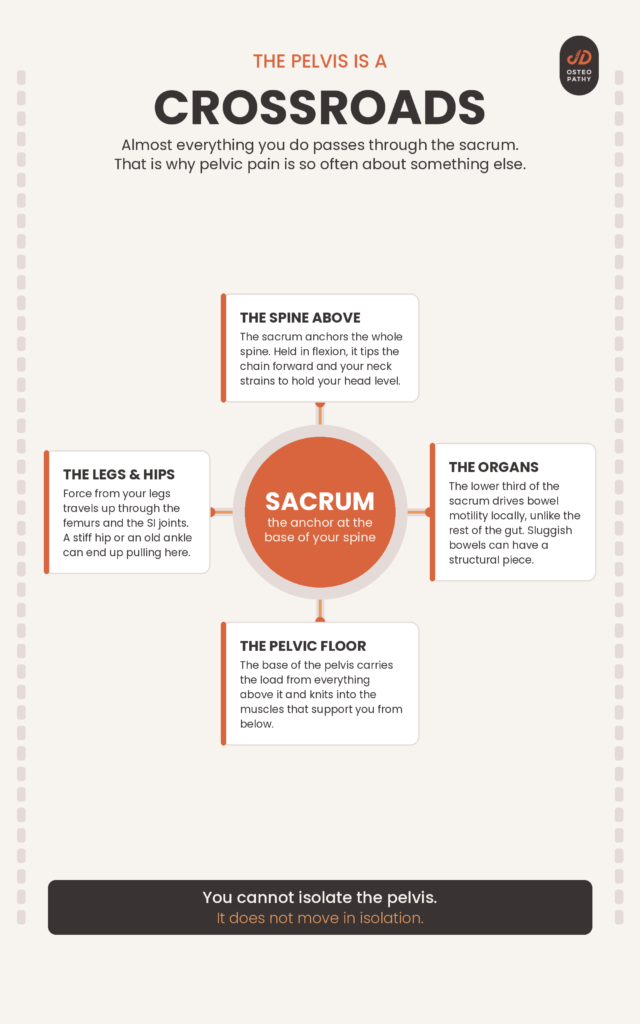
The pelvis and sacrum are almost always where that recruitment ends up. They sit at the crossroads of the body, so they are the final destination for whatever the rest of you is trying to accomplish.
Why the painful pelvis is usually the messenger
Think of a car with a rough ride. You feel it in the tire and the wheel, so that is where you look. But the noise and the bumping can come from the suspension, the alignment, or the road itself. The tire is just the part where you finally feel the problem.
Your pelvis works the same way. The area that hurts is often the loyal worker doing everyone else’s job. It moves because it can, so it takes on the load that a stiffer, quieter area nearby has quit doing. The restricted area is not painful, because it is not moving. The painful area is not the source. It is the one paying the bill.
This is why so many people get their pelvis treated over and over with only short-term relief. If you keep working on the part that is already overworked, you are treating the symptom and leaving the cause alone.
The one joint almost everyone has something going on at
Most people who walk into the clinic have, in some form, something happening at the base of their spine, where the lowest lumbar vertebra meets the sacrum. It is the anchor point for the entire spine above it. When that anchor is not moving well, the effects travel a long way. This is the same reason why it’s always important to be cautious of improperly diagnosing a pelvic tilt as a pelvic issue, when there could be something else creating the postural issue.
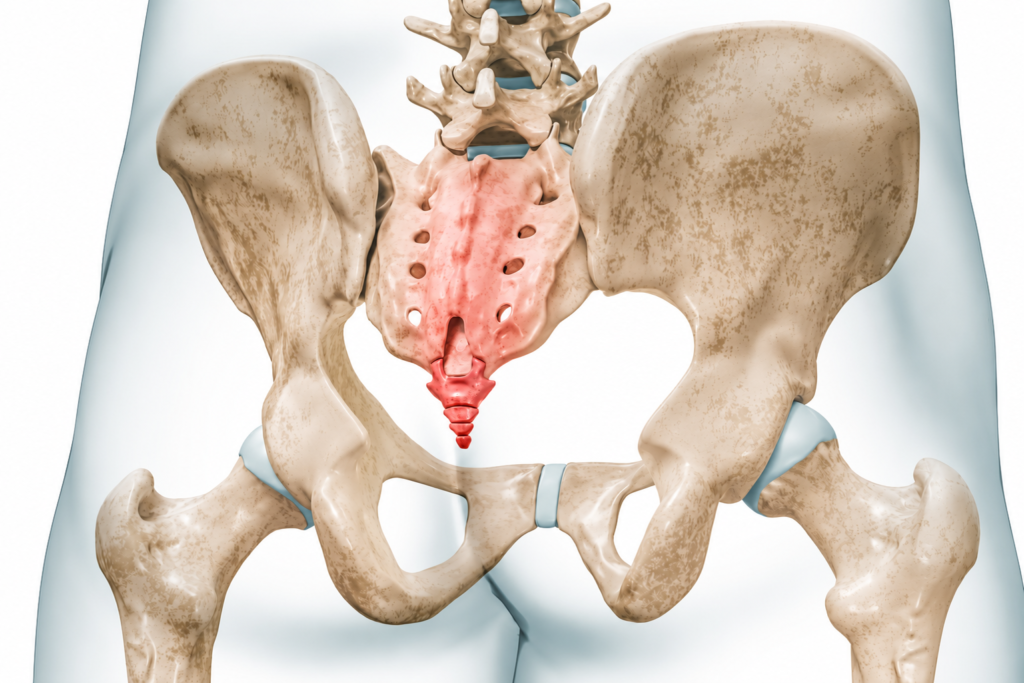
A quick bit of language, because it helps the rest make sense. In osteopathy we call each half of the pelvis an innominate. Each one is built from three bones, the ilium, the ischium, and the pubic bone, that fuse together into one in adulthood. You have a left innominate and a right one, and the sacrum sits like a keystone between them at the back. The catch is that the innominates and the sacrum move in tandem, and sometimes in opposite directions, depending on whether your legs are planted and your spine is moving, or your spine is fixed and your legs are moving. The combinations are effectively endless. That complexity is the whole reason pelvic problems get missed. There is a lot going on, and it is easy to stare at the sore spot and never ask what is pulling on it.
The connections that surprise people
Because the sacrum anchors the spine, its reach goes further than most people expect. Two examples land hardest in the room.
The first is neck and upper back pain. When the sacrum is held in a flexed position, it can hold the lumbar spine in flexion too, which tips the whole chain forward. Your neck then has to work constantly to hold your head up and level, and those muscles strain from the effort. People are genuinely surprised to hear that their nagging neck tension might trace back to the base of their spine, but the spine is one connected column, and the anchor sets the tone for everything above it.
The second is your digestion, specifically the lower bowel. Most of your digestive system gets its rest-and-digest signal from the head, travelling down through the vagus nerve. The lower part of the bowel is the exception. It gets its signal locally, from the lower third of the sacrum. So sluggish bowel movements can, for some people, have a structural component at the sacrum that nobody thought to check. If that connection interests you, it is the subject of how osteopathy approaches digestion and gut mobility.
I am not saying every stiff neck or sluggish gut is a sacral problem. I am saying the sacrum reaches far enough that it belongs on the list of suspects, and it rarely makes anyone’s list.
What this means when you come in for pelvic pain
If you come in pointing at your SI joint or your tailbone, the first thing I do is agree with you. There is something going on there. That part is real, and it is also the easy part, because you already know it. We do not need to spend the whole session harping on the spot you can already feel.
The hard question is why. So I keep asking questions, and I assess the areas around and connected to the pelvis, whether there is hip pain and restriction interacting with the lumbar spine, the old injuries you have half-forgotten. I am not ignoring your complaint by looking elsewhere. I am trying to tell cause from effect, so we can say with confidence what is driving what. That means checking whether something is stopping the pelvis from working, or whether the pelvis is the thing causing trouble elsewhere. We need the whole story, and we try not to get too caught up in the site of the pain.
That is the same principle behind why an osteopathic practitioner often treats areas away from where it hurts, and it is why an old injury you forgot about can be the reason you hurt now.
When to see a doctor first with Sacral Pain
Manual osteopathy is not the right first stop for everything in this region. Some signs point to something that needs a physician right away, not a hands-on treatment. Get assessed medically first if you have any of these:
Loss of bowel or bladder control. Sudden numbness or loss of sensation in the tailbone, the saddle area, or the genitals. Severe pain, or bleeding from the bowel. These are not manual therapy problems, and they should be looked at by a doctor immediately.
Once anything serious has been ruled out, structural and movement-related pelvic pain is very much something manual osteopathy can help with.
The takeaway
The pelvis and sacrum are the crossroads of the body. Almost everything you do passes through them, which is exactly why they so often end up sore, and exactly why the soreness is so often a symptom of something happening elsewhere. You cannot isolate the pelvis, because it does not move in isolation. The goal is not to chase the painful spot around. It is to zoom out, find what is really pulling the strings, and treat that.
If you find that your lower back pain is constantly lingering, hip, or pelvic pain keeps coming back no matter what you do to the sore spot itself, that pattern is the clue. It is telling you the source is somewhere you have not looked yet.
Book your appointment in Mississauga
Book your appointment in Burlington
No referral required. Initial $110, follow-up $85.
JD Osteopathy serves patients across Mississauga and Burlington. Our osteopathic practitioners hold a Master in the Practice of Osteopathic Manipulative Sciences (M.OMSc.) from the Canadian Academy of Osteopathy, the highest level of osteopathic education available in Ontario.
About the author: Dmitro Jovnyruk, M.OMSc. is an Osteopathic Manual Practitioner and Founder of JD Osteopathy with clinics in Mississauga and Burlington. His practice focuses on identifying the underlying mechanical causes of pain and discomfort through osteopathic assessment and treatment. Read Full Bio
2 Comments
Comments are closed.