Osteopathy for Digestion: Why It Is Rarely Just a Gut Problem
The short version: Most people do not come get osteopathy for digestion issues at first. They come in for neck or back pain and mention on the intake form that their digestion is off or their bowels are irregular. Then they notice something. Their gut flares up around the same time their back or neck does. That is not a coincidence. Your organs need good blood supply and clear nerve signals to work well, exactly like your muscles do, and a lot of what governs that runs through your rib cage, your neck, your diaphragm, your lower back, and your pelvis. Osteopathy does not treat your organs or any digestive condition. It works on the structure around them, so the area has the best possible environment to do its own job. Not to mention, if you ever have sharp or shooting abdominal pain, especially on the right side, that is a see-a-doctor-first situation, not an osteopathy one.
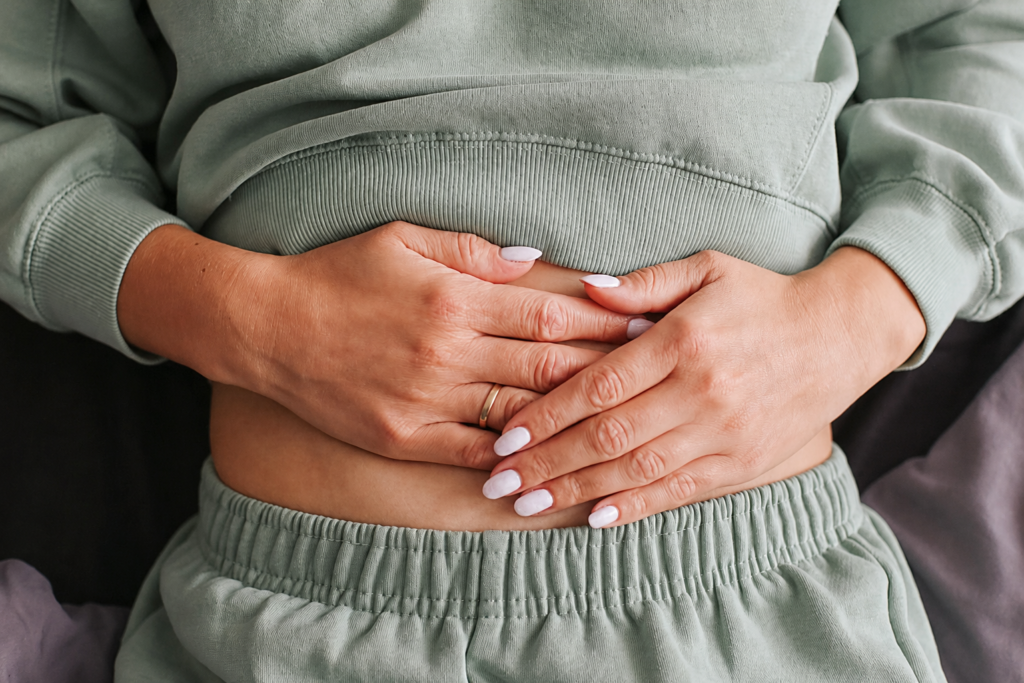
Most people do not come get Osteopathy for digestion…at first.
In the room, digestion is rarely the headline. Someone books for neck pain or a stiff lower back, and somewhere on the intake form they tick that their digestion is sluggish or their bowel movements are irregular. When I ask about it in relation to their musculoskeletal complaint, a pattern shows up again and again. Their digestive symptoms tend to flare when their back or neck flares, and settle when those settle.
That link is the whole story of this post. To see why the two travel together, you have to stop thinking of the gut as a sealed-off system.
Organs need blood, the same as your muscles do
Here is how I explain it on the table. Just like your muscles and joints, your organs need blood to work and to heal, and so do the nerves that run them. Nerves need blood to send their signals properly.
You already know this feeling. When you sleep funny and your arm falls asleep, the muscle goes weak and the skin goes numb, because the nerve was starved of blood. Move the arm around, restore the supply, and the sensation comes back. Your organs are no different. They need that same supply coming in and that same drainage going out, the veins and the lymphatic system clearing the area, so the nerve stays fed and the tissue stays healthy.
When something in the body does not move well, circulation to that area drops. The body does not pick and choose. It does not decide to spare your arm but starve your gut. It reduces flow to the compromised area, and whatever lives there, muscle or organ, is affected the same way. The only difference is that different tissues express the problem differently. A muscle gets tight or sore. An organ gets sluggish. In osteopathy we do not romanticize or stress one area over another. A muscle and an organ are both vital, and both get treated as such.
We have systems in place to help pump blood around the body, like the diaphragm muscle (our breathing muscle) which acts like a respiratory pump and transfers air and our blood between compartments of the rib cage, and abdomen. When your spine, ribs, hips or even your neck (where the nerves to the diaphragm originate) you can’t expect the body to efficiently pump blood and fill our lungs with air. Not everything is complicated in concept, it’s just about making sure the body can do what it’s designed to do, we don’t have to reinvent the wheel and micromanage the body. It’s about restoring the anatomical environment to let the body do its thing.
Find it, Fix it, and Leave it Alone. – Dr. Andrew Taylor Still (founder of Osteopathy)
Stress pulls blood away from your gut
Some of the biggest influences on your digestion are not signals from your digestive system at all. They come from your nervous system, and from two branches of it in particular.
The first is your stress response, the sympathetic system. The nerves for it run in a chain right behind the rib heads, where your ribs attach to your spine. When that system fires, blood gets sent out to your arms, legs, and head, toward the big muscles. Think go go go, I have to run. In that state your body shunts blood away from the digestive tract, because digesting lunch is not the priority when you are trying to sprint. That is useful in a real emergency. It is less useful when the switch is stuck on for weeks.
The other branch is rest and digest, the parasympathetic system. It does the opposite, pulling blood back to your center and away from the extremities. You have felt this one too. Eat a big meal and you go sleepy and heavy, because blood is being routed to your middle to get on with digestion.
Your gut takes its cues from your neck and your sacrum
The main rest-and-digest supply to your organs is the vagus nerve, and it starts at the base of your skull. It feeds most of your digestive tract on its way down. The exception is the last third of your large intestine, which is supplied from the sacrum at the base of your spine. That single fact is useful in practice. Anything on the constipation side sends me to look at the sacrum. Anything higher up the digestive tract sends me to the head and neck, to follow the vagus down. Whether it’s the sacral pain causing the issue or sacral pain coming from somewhere else in the body, the digestive system will be somehow affected.
So if your neck is stiff and you cannot rotate well, that can drag on the vagus and the signal it carries. And as you follow those nerves down through the body, you keep meeting the same crossroads, the diaphragm, the rib cage, the lower back, the pelvis. Which structure matters most depends entirely on what is going on in that person, not on the gut in isolation. This is the same whole-body reasoning behind why we treat areas away from where it hurts. Osteopathy for digestion or elimination doesn’t always mean you have to treat the area around the organ, it’s also about what is happening to and from the rest of the body.
A hip flexor that helps move your colon
Here is one connection most people never hear about. Your right psoas, the deep hip flexor, is an intersecting point for the root of the mesentery and blends the fascia, the netting holding everything together with the colon and kidneys. The mesentery is a double-layered sheet that holds your colon in place and keeps it sturdy, and it ties into your rib cage, your spine, and that right hip flexor. Picture a vacuum-sealed sausage. That thin double sheet keeps everything neatly held together. Every time you walk and move, you are gently moving your colon and everything else attached to that sheet.
Now think about what happens when the lower back where the psoas attaches is restricted, or the diaphragm, which also attaches to the front of the lumbar spine, is tight. You get a knock-on effect on the blood supply and the nerve communication to that whole area. This is why people so often come in with a stiff or painful lower back, hip flexor, or pelvis, and mention that they are also constipated or bloated, especially when the left side of the sacrum and lower back is irritated. There is almost always some effect on the viscera riding along with it. Once you address the musculoskeletal complaint, the body can move blood to and from the area again, the nerve is happy, and the digestive complaints tend to quiet down on their own.

How your hip flexor tugs on your gut
The psoas runs from L1 to L5 and shares a continuous fascial plane with the kidney, ureter and colon. Slide from extended to flexed and watch the contents get drawn along.
What we are, and are not, doing
This is the part worth being very clear about. Osteopathy for digestion is complex, and that complexity gets used to sell fancy, proprietary-sounding treatments. But we do not control the function of your digestive system. No hands can do that. What we can control is the structural environment that system works in, and make sure it is the best it can be so the body can do its own job well.
So the rule I work by is simple. You cannot assume a problem is a digestive or organ problem until you have ruled out that it is not a structural, musculoskeletal one. We work from the outside in. We address the mechanical issues first, and if there is still tension left through the abdomen or around an organ, we use gentle soft tissue and fascial techniques to pick up what remains and calm the area. This hands-on work with the structures around the organs is what people usually mean by visceral osteopathy. That is not treating the organ. It is treating the area around it, so blood can supply the nerve and drain the tissue the way it should. This is also part of what the hands are assessing for throughout a session. If you want the fuller picture of how we handle this as a service, that lives on our digestive and visceral complaints page.
What a visceral session feels like
Most people brace for this kind of work. Visceral osteopathy has a reputation for deep digging and hard pushing into the belly. It is almost never like that because the goal of osteopathy for digestion, is to work toward the area, not right at it. By the time we reach the abdomen, we have already released so much of the surrounding tension that there is very little left to do. It is rarely productive to push hard through the belly anyway, because it is such a sensitive area. Straining it tends to irritate it further, which is the opposite of the goal. So we go soft, we follow where the tissue wants to go, and we work to calm the area down rather than fight it. The techniques are gentle, and most people find them settling.
When to see your doctor first
One clear safety point, because it matters most here. If you have sharp or shooting pain in your abdomen, especially on the right side, see a doctor immediately. That can be an emergency, such as acute inflammation of an organ like the appendix, and a manual osteopathic practitioner is not equipped to diagnose that. I have flagged exactly this in my own practice more than once and sent people straight to a doctor. As a rule of thumb in Ontario, if you are ever in doubt, get checked at your doctor or even a walk-in clinic first. Better to be safe than to guess.
Once anything that needs medical attention has been ruled out, the structural, movement-related side is where visceral osteopathy can help set you up in the best possible situation.
Book an appointment
If your digestion tends to flare alongside your back, neck, or hips, that whole-body pattern is exactly what I look at as a Mississauga osteopath.
Book your appointment in Mississauga
Book your appointment in Burlington
No referral required. Initial $110, follow-up $85.
JD Osteopathy serves patients across Mississauga and Burlington. Our osteopathic practitioners hold a Master in the Practice of Osteopathic Manipulative Sciences (M.OMSc.) from the Canadian Academy of Osteopathy, the highest level of osteopathic education available in Ontario.
About the author: Dmitro Jovnyruk, M.OMSc. is an Osteopathic Manual Practitioner and Founder of JD Osteopathy with clinics in Mississauga and Burlington. His practice focuses on identifying the underlying mechanical causes of pain and discomfort through osteopathic assessment and treatment. Read Full Bio