
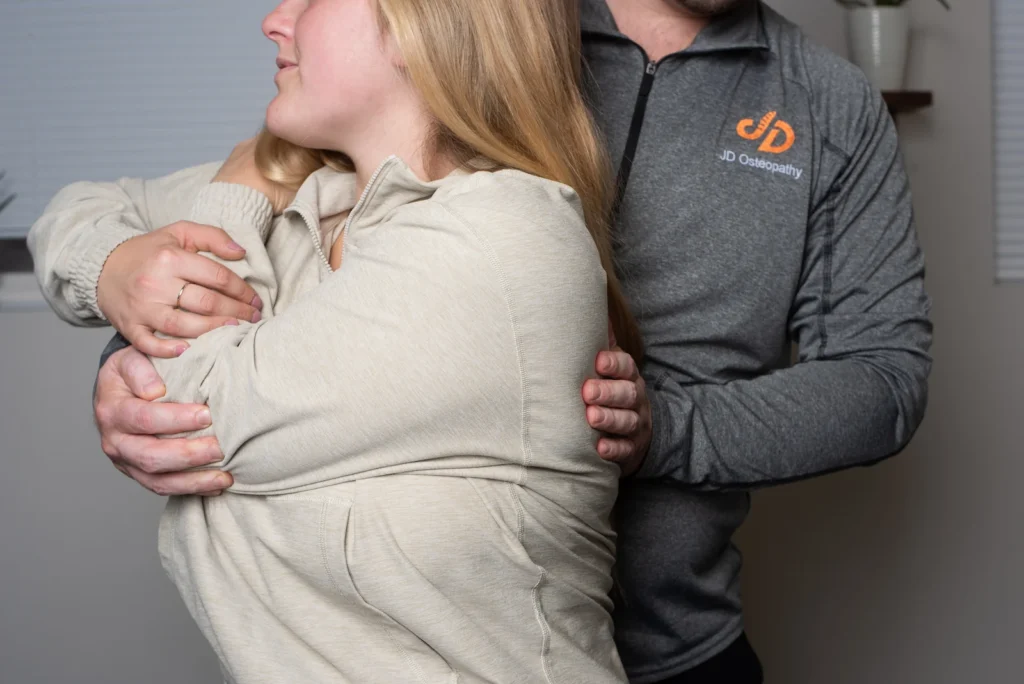
Why Rib Pain and Breathing Problems Are Rarely About the Ribs
Most people don’t think about their ribs until something feels wrong with them. Then it’s hard to think about anything else. A catch when you twist or sneeze. A spot between the shoulder blades that won’t release. The sense that you can’t quite get a full breath in, or push a full breath out. Tightness across the chest or rib pain that you had checked, and your heart is fine, but the feeling stayed.
If you have chest pain, especially with shortness of breath, sweating, or pain spreading into the arm or jaw, please see a doctor or go to emergency first. Rib pain specifically in the chest can come from the heart, and that always gets ruled out before we look at anything mechanical. This post is about the musculoskeletal side of rib and breathing complaints, the kind that remain once the serious causes have been excluded.
The ribs and the stress response are wired together
There is a piece of this that almost nobody is told about, and it explains why rib and breathing complaints so often travel with feeling wound up.
Running right alongside the rib attachments on the spine is the sympathetic chain, the nerves behind your fight-or-flight response. The ribs sit in direct physical relationship with the part of your nervous system that handles stress. And it runs in both directions. When we are stressed, we tend to exhale and hold, and because exhaling flexes the spine forward through the ribs, stress quite literally pulls the body into a hunched, braced position. The breath and the posture are not separate problems. One drives the other.
So when someone feels anxious or stressed and also notices their breathing feels shallow and their chest feels tight, I am not treating their anxiety, I want to be clear about that. I am looking at the physical, mechanical side of a stress response that is showing up in how the ribs and spine are moving. That is the lens I work through: anatomy, not mood.
This is also why posture rarely tells the whole story. Posture is often a byproduct of what the body can’t do, not the cause of the problem. If you are perpetually sitting, looking down at a phone and a screen, and carrying tension, the ribs get used to that forward, braced position and start to strain in it.
What this looks like in a real body
Here is a pattern I see often, put together from many similar presentations.
Someone comes in for pain between the shoulder blades. It seems obvious, the upper back hurts, so the upper back must be the problem. But when I assess them, the actual driver is at the front, lower down. The diaphragm anchors onto the front of the lumbar spine, and in this person it was holding the lower back in a flexed, hunched position. To stop their head from falling forward, the body did what bodies do, it fought to create equilibrium. The upper back worked overtime to extend and hold the head up against that downward pull.
That constant fight is what strained the area between the shoulder blades. But there was a second cost they hadn’t connected to it. All that holding was also straining the back of the ribs and quietly increasing the demand on their breathing. They came in for shoulder blade pain and had no idea their breath was part of the same story.
Once we improved the mechanism and got the lumbar spine able to extend again, the upper back no longer had to fight to hold them upright. Now, it could let go and with the spine moving freely, the ribs could move freely too. The person left with less musculoskeletal pain, and also feeling calmer, because their ribs could finally breathe easier. This is why osteopathic treatment of the ribs have consistent success at JD Osteopathy, especially with proper osteopathic structural assessment. That is the whole-body picture, and you cannot get to it by treating the spot that hurts.
How we actually approach it at JD Osteopathy
Because the rib is usually the passenger, the assessment works from the inside out.
First we rule out the spine. Any spinal restriction will create rib pain, or restriction, because they are directly attached, so the spine has to be clear before we put any blame on the rib. We check the soft tissue of the abdomen too, since that pulls on the rib cage from below.
Then we make sure the diaphragm, your main breathing muscle, is getting a clean signal from the neck, because the nerve that drives it comes from the upper cervical spine. If that signal is obstructed, the whole breathing mechanism is working against a handicap.
Only then do we assess the ribs themselves, checking that they actually move properly through both inhalation and exhalation. There is also a quiet relationship here with the nerves that influence the internal organs, the first few ribs relating to the heart and lungs, the middle ribs to the digestive organs higher in the abdomen, the lower ribs to the gut further down. When rib movement is restricted, that system can feel the effects too, which is a thread I’ll pull on properly in a separate post on visceral and digestive work.
When the ribs can move freely again, the body can transfer air and fluid between the chest and the abdomen the way it is meant to, the diaphragm pumps properly, and there is simply less strain in every breath, in and out. Patients tend to describe it as feeling lighter.
The principle underneath all of this
Rib pain is a symptom. We cannot assume it is the cause. Every person who walks in is a different combination of history, habit, and structure, and the number of ways these patterns can connect is effectively infinite. That is exactly why osteopathy works on principles rather than a fixed set of techniques. Without the reasoning, this kind of problem-solving cannot happen, and the person does not get the help they actually came for.
If you have been dealing with rib pain, a catch in your breathing, or tension across your chest and upper back that nothing seems to shift, it may be worth looking at the whole system rather than the spot that hurts.
With that said, here is the thing about ribs that changes how you understand the problem.
Your ribs are built to be rigid
The rib cage has a job, and that job is protection. Your heart and lungs sit inside it, so the ribs are designed to be sturdy and stable, not loose and mobile. They do not pop out of place. Patients often tell me their rib is “out,” and I understand why it feels that way, but a rib genuinely displacing would be a serious, traumatic injury, because of how much sits packed around it. What feels like a rib out of place is almost always a rib that has stopped moving the way it should.
And here is the key idea. Because ribs are built to be rigid, they are usually not the thing causing the problem. They are the passenger. Each rib attaches directly to the spine at the back, so wherever the spine goes, the rib is tethered along for the ride. With rib pain, something is usually pulling on it. That is why, before I ever blame the rib, I look at what it is attached to.
Every breath moves your whole spine
This is the part that is hard to picture in words, so I built something you can move yourself.
Side view. A single breath moves the whole spine, ribs and diaphragm together. From the side you can see the pump-handle motion of the upper ribs, where the front lifts on the inhale. The bucket-handle and caliper motions of the middle and lower ribs happen front-on, so they are not shown here.
Slide between exhale and inhale, or press breathe and watch it cycle. Notice what happens. On the inhale, the front of the ribs lifts up and forward to make room for the lungs, and the whole spine extends to follow. On the exhale, the front of the ribs drops down and back, and the spine flexes forward. The sacrum tips. The neck shares it. This is not just the chest moving. One breath travels the entire spine, from the base of the skull to the sacrum.
That motion has to happen, thousands of times a day. The ribs do not get a day off. So when a restriction somewhere holds the body in one direction, the demand on the ribs keeps coming anyway, and at some point the demand exceeds what the restricted area can deliver. That mismatch is where the irritation shows up. The rib pain you feel is the symptom of a movement that is being asked for and can't fully happen.
Don't wait and suffer with rib pain or breathing difficulties, get it sorted. We're here to help, make an appointment and let's figure this out!
JD Osteopathy serves patients across Mississauga and Burlington. Our osteopathic practitioners hold a Master in the Practice of Osteopathic Manipulative Sciences (M.OMSc.) from the Canadian Academy of Osteopathy, the highest level of osteopathic education available in Ontario.
About the author: Dmitro Jovnyruk, M.OMSc. is an Osteopathic Manual Practitioner and Founder of JD Osteopathy with clinics in Mississauga and Burlington. His practice focuses on identifying the underlying mechanical causes of pain and discomfort through osteopathic assessment and treatment. Read Full Bio
One Comment
Comments are closed.